Quick Answer
The most common animals in French are le chien (dog), le chat (cat), le cheval (horse), l'oiseau (bird), and le poisson (fish). Every animal noun in French has a grammatical gender, le or la, which must be memorized individually. Some animals have separate masculine and feminine forms (le chien / la chienne), while others use one fixed gender regardless of the animal's actual sex (la girafe is always feminine, le serpent is always masculine).
Learning animal names in French is one of the most practical vocabulary investments you can make. Animals appear everywhere in the French language: in everyday conversation, in dozens of idioms that native speakers use daily, in La Fontaine's fables that every French child knows by heart, and in the cultural symbolism of France itself, where le coq gaulois (the Gallic rooster) stands as a national emblem. Knowing les animaux means more than labeling creatures; it means unlocking an entire layer of French expression.
With approximately 321 million speakers across 29 countries according to the Organisation internationale de la Francophonie's 2024 report, French spans ecosystems from the Alpine ibex of the French Alps to the gorillas of the Congo Basin to the marine life of French Polynesia. The vocabulary reflects this geographic range: standard French carries terms for European farm animals alongside words absorbed from Francophone Africa and the Caribbean.
"Animal vocabulary in every language reveals not just what creatures a culture encounters, but what it values. French animal idioms, from the loyal chien to the industrious fourmi, encode centuries of rural life, literary tradition, and folk wisdom into everyday speech."
(David Crystal, The Cambridge Encyclopedia of Language, Cambridge University Press)
This guide covers 50+ French animal names organized into six categories, with pronunciation, grammatical gender, cultural context, and the idioms that bring these words to life. For interactive practice with real French content, visit our French learning page.
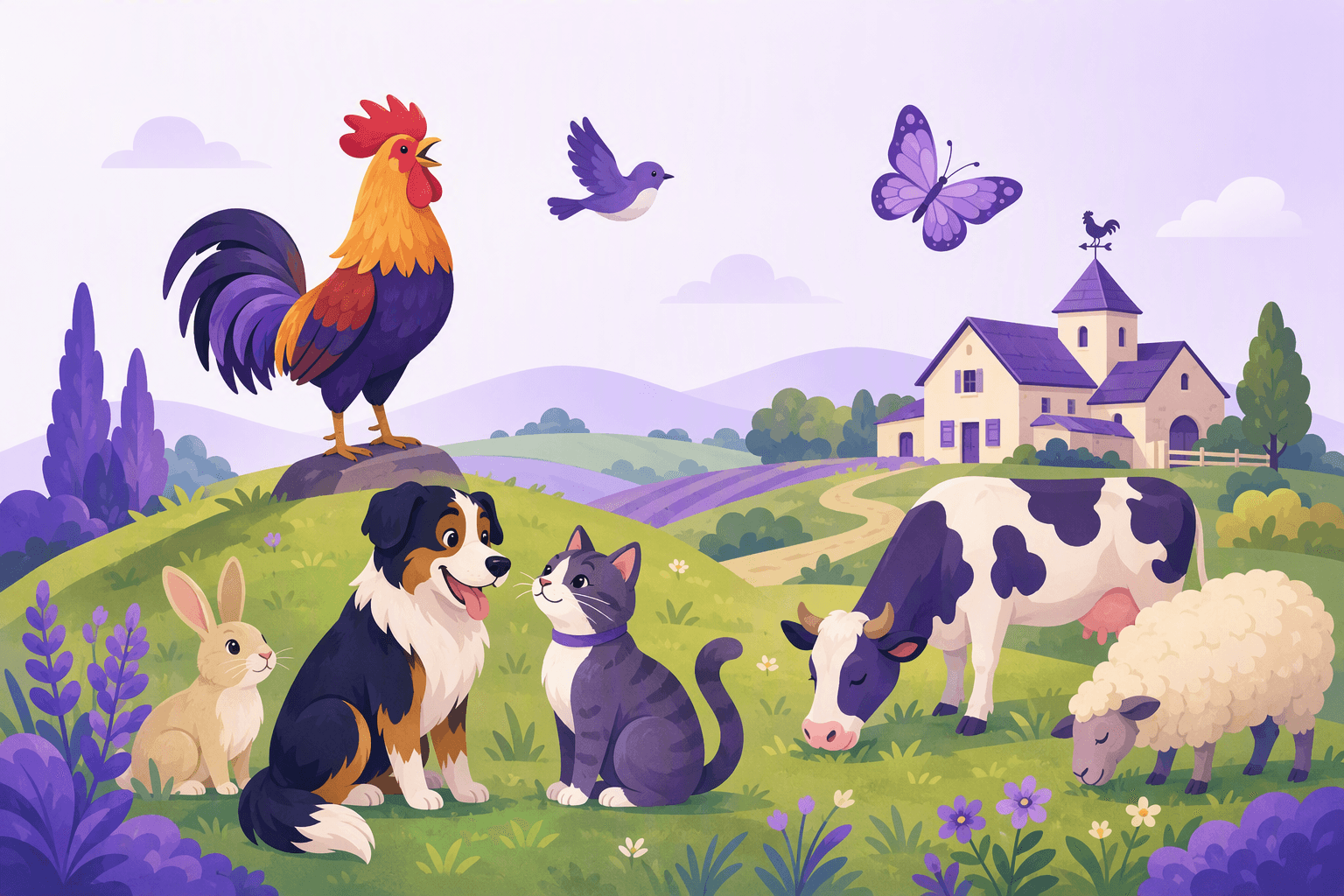
Quick Reference: Essential French Animals
These are the animal words you will encounter most frequently in everyday French. The note column indicates grammatical gender and any important irregular forms.
| English | French | Pronunciation | Note |
|---|---|---|---|
| Dog | Le chien | luh shee-EN | m. (f: la chienne) |
| Cat | Le chat | luh shah | m. (f: la chatte) |
| Horse | Le cheval | luh shuh-VAL | m. (f: la jument) |
| Bird | L'oiseau | lwah-ZOH | m. (pl: les oiseaux) |
| Fish | Le poisson | luh pwah-SOHN | m. |
| Cow | La vache | lah vahsh | f. (m: le taureau) |
| Rabbit | Le lapin | luh lah-PAN | m. (f: la lapine) |
| Pig | Le cochon | luh koh-SHOHN | m. (f: la truie) |
| Sheep | Le mouton | luh moo-TOHN | m. (f: la brebis) |
| Chicken | La poule | lah pool | f. (m: le coq) |
| Lion | Le lion | luh lee-OHN | m. (f: la lionne) |
| Butterfly | Le papillon | luh pah-pee-YOHN | m. |
Pets: Les Animaux de Compagnie
France has one of the highest pet ownership rates in Europe, with over 80 million pets across the country. Pet vocabulary comes up constantly in daily conversation.
| English | French | Pronunciation | Note |
|---|---|---|---|
| Dog | Le chien | luh shee-EN | m. (f: la chienne) |
| Cat | Le chat | luh shah | m. (f: la chatte) |
| Bird | L'oiseau | lwah-ZOH | m. |
| Fish | Le poisson | luh pwah-SOHN | m. |
| Rabbit | Le lapin | luh lah-PAN | m. (f: la lapine) |
| Turtle / Tortoise | La tortue | lah tor-TOO | f. |
| Hamster | Le hamster | luh ahm-STEHR | m. (h is silent) |
Le chien
The dog holds a special place in French culture and language. Le chien is masculine, with la chienne as the feminine form. French has a rich set of dog-related expressions: un temps de chien (dog weather, meaning terrible weather), avoir du chien (to have dog, meaning to have charm or allure), and entre chien et loup (between dog and wolf, meaning twilight, the moment when you cannot distinguish one from the other).
Le chat
Le chat (masculine) becomes la chatte (feminine). Cats feature prominently in French idioms. Donner sa langue au chat (to give your tongue to the cat) means to give up trying to guess the answer. Avoir d'autres chats à fouetter (to have other cats to whip) is the French equivalent of "to have bigger fish to fry." The famous Chat Noir cabaret in Montmartre, which operated from 1881 to 1897, made the black cat an enduring symbol of Parisian bohemian culture.
Le lapin
Le lapin (rabbit) is the source of one of the most commonly used animal idioms in French. Poser un lapin à quelqu'un (to place a rabbit on someone) means to stand someone up, to not show up for a date or meeting. The origin of this expression dates to the 19th century and remains debated among linguists. The Académie française's dictionary notes the phrase as standard informal French.
Farm Animals: Les Animaux de la Ferme
France's agricultural identity is deeply embedded in its language. These words echo through centuries of rural life, literature, and national symbolism.
| English | French | Pronunciation | Note |
|---|---|---|---|
| Cow | La vache | lah vahsh | f. (m: le taureau / le boeuf) |
| Horse | Le cheval | luh shuh-VAL | m. (f: la jument, pl: les chevaux) |
| Pig | Le cochon | luh koh-SHOHN | m. (f: la truie) |
| Hen / Chicken | La poule | lah pool | f. (m: le coq) |
| Sheep | Le mouton | luh moo-TOHN | m. (f: la brebis) |
| Goat | La chèvre | lah shehv-ruh | f. (m: le bouc) |
| Donkey | L'âne | lahn | m. (f: l'ânesse) |
La vache
La vache is always feminine. The masculine counterpart is le taureau (bull) or le boeuf (ox/steer). French speakers use oh la vache ! as a common exclamation of surprise, roughly equivalent to "holy cow!" in English. The expression la vache ! is considered mild and family-friendly, used by speakers of all ages.
Le cheval
Le cheval has an irregular plural: les chevaux (shuh-VOH). The feminine form la jument (mare) is a completely different word, not a modified form. This is common among French farm animals: the male and female often have entirely separate words rather than a suffix change. Monter à cheval means to ride a horse, and à cheval (on horseback) metaphorically means straddling two things.
Le coq
Le coq (rooster) deserves special attention as a French national symbol. Le coq gaulois (the Gallic rooster) became associated with France through a Latin wordplay: gallus means both "rooster" and "Gaul" (the ancient name for France). The rooster appears on the jerseys of the French national football and rugby teams, on church weathervanes across the country, and on official stamps. French sports fans call their teams les Bleus, but the rooster emblem is what makes the uniform unmistakably French.
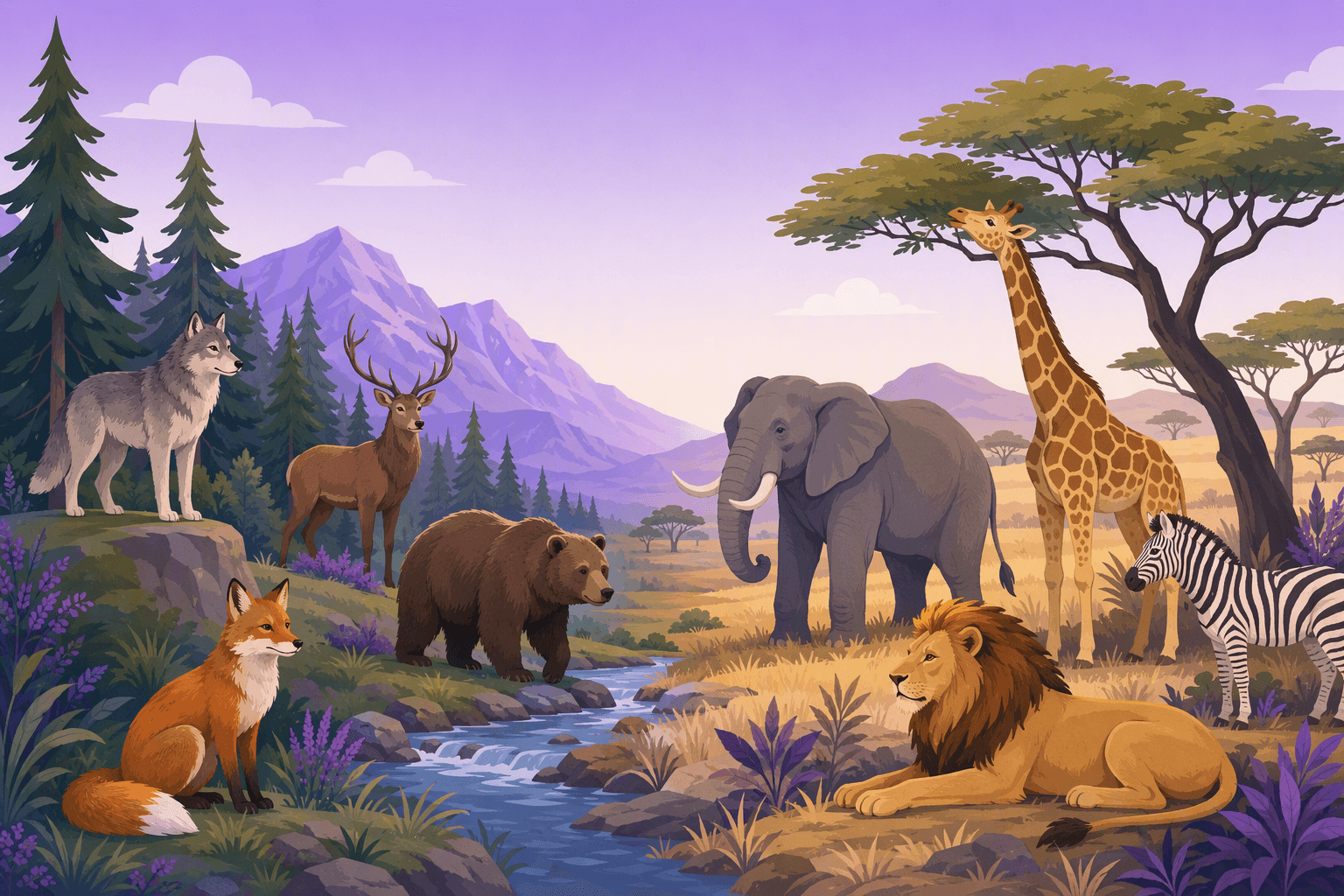
Wild Animals: Les Animaux Sauvages
From the forests of metropolitan France to the savannas of Francophone Africa, the French-speaking world covers an extraordinary range of wildlife habitats. According to the IUCN Red List, France alone (including overseas territories) hosts over 18,000 animal species.
| English | French | Pronunciation | Note |
|---|---|---|---|
| Lion | Le lion | luh lee-OHN | m. (f: la lionne) |
| Tiger | Le tigre | luh tee-gruh | m. (f: la tigresse) |
| Bear | L'ours | loors | m. (f: l'ourse) |
| Wolf | Le loup | luh loo | m. (f: la louve) |
| Fox | Le renard | luh ruh-NAR | m. (f: la renarde) |
| Deer | Le cerf | luh sehr | m. (f: la biche) |
| Monkey | Le singe | luh sanzh | m. (f: la guenon) |
Le loup
Le loup (wolf) powers one of the most useful French idioms: avoir une faim de loup (to have a wolf's hunger) means to be absolutely starving. French also says quand on parle du loup, on en voit la queue (speak of the wolf and you see its tail), the equivalent of "speak of the devil." The wolf looms large in French literary tradition, from Charles Perrault's Le Petit Chaperon Rouge (Little Red Riding Hood) to Jean de La Fontaine's fables, where le loup appears as a recurring character representing cunning and danger.
Le renard
Le renard (fox) owes its very name to literature. The original French word for fox was goupil, but the 12th-century satirical epic Le Roman de Renart, featuring a trickster fox named Renart, was so popular that the character's name replaced the common noun entirely. This is one of the rare cases in any language where a fictional character's name permanently displaced the original word. According to the Académie française, renard fully replaced goupil by the 15th century.
Le cerf
Le cerf (deer/stag) has a silent final consonant: it is pronounced "sehr," not "serf." The feminine form la biche (doe) is a separate word. Ma biche (my doe) is used as a term of endearment in some regions, similar to "my dear." French distinguishes carefully: le cerf (stag), la biche (doe), and le faon (fawn, pronounced "fahn").
Sea Animals: Les Animaux Marins
France has over 5,500 kilometers of coastline along the Atlantic, Mediterranean, English Channel, and its overseas territories in the Pacific and Caribbean, making marine vocabulary highly practical.
| English | French | Pronunciation | Note |
|---|---|---|---|
| Whale | La baleine | lah bah-LEHN | f. |
| Dolphin | Le dauphin | luh doh-FAN | m. (also: heir to the throne) |
| Shark | Le requin | luh ruh-KAN | m. |
| Octopus | Le poulpe | luh poolp | m. (also: la pieuvre) |
| Crab | Le crabe | luh krahb | m. |
| Jellyfish | La méduse | lah meh-DOOZ | f. (from Greek Medusa) |
Le dauphin
Le dauphin carries a double meaning that is unique to French history. Beyond "dolphin," le dauphin was the title given to the heir apparent to the French throne from the 14th to the 19th century. The title originated from the Dauphiné region (whose coat of arms featured dolphins), and it became permanently associated with the royal succession. When French speakers hear dauphin, context determines whether they picture a marine mammal or a political successor.
La méduse
La méduse (jellyfish) takes its name directly from the Greek mythological figure Medusa, whose writhing snake hair resembled the tentacles of the creature. French consistently names jellyfish with this mythological connection, while English chose the more literal "jellyfish." The word is always feminine, following the gender of the mythological character.
Birds: Les Oiseaux
French distinguishes a rich vocabulary of bird species, many of which appear in La Fontaine's famous Fables (1668-1694), a collection that remains required reading in French schools to this day.
| English | French | Pronunciation | Note |
|---|---|---|---|
| Eagle | L'aigle | legl | m. (f: rare, l'aigle f. in heraldry) |
| Owl | Le hibou | luh ee-BOO | m. (pl: les hiboux) |
| Parrot | Le perroquet | luh peh-roh-KEH | m. (f: la perruche = parakeet) |
| Pigeon | Le pigeon | luh pee-ZHOHN | m. (also: gullible person) |
| Penguin | Le pingouin | luh pan-GWAN | m. (le manchot = flightless) |
| Flamingo | Le flamant | luh flah-MAHN | m. (le flamant rose) |
Le corbeau
While not in the table above, le corbeau (crow/raven) deserves mention for its literary significance. La Fontaine's fable Le Corbeau et le Renard (The Crow and the Fox) is arguably the most famous French fable, a story in which the fox flatters the vain crow into dropping its cheese. Every French schoolchild can recite its opening: Maître Corbeau, sur un arbre perché... (Master Crow, perched upon a tree...). In modern slang, un corbeau also means an anonymous poison-pen letter writer.
Le pigeon
Le pigeon serves double duty in French. Beyond the bird, it is common slang for a gullible person, someone easily swindled. Se faire pigeonner (to get pigeoned) means to be conned or ripped off. Paris has a famously dense pigeon population, and les pigeons parisiens have become as iconic as the Eiffel Tower itself.
Insects: Les Insectes
Insect vocabulary in French is especially important for idioms, since several of the most common French expressions involve bugs and creepy-crawlies.
| English | French | Pronunciation | Note |
|---|---|---|---|
| Butterfly | Le papillon | luh pah-pee-YOHN | m. |
| Bee | L'abeille | lah-BAY | f. |
| Ant | La fourmi | lah foor-MEE | f. |
| Spider | L'araignée | lah-reh-NYEH | f. |
| Fly | La mouche | lah moosh | f. |
| Mosquito | Le moustique | luh moo-STEEK | m. |
La fourmi
La fourmi (ant) stars in one of La Fontaine's most famous fables: La Cigale et la Fourmi (The Cicada and the Ant), a story about the industrious ant who prepares for winter while the carefree cicada sings all summer. The moral (that hard work and foresight are rewarded) remains deeply embedded in French cultural values. The expression un travail de fourmi (ant's work) describes meticulous, painstaking labor.
Le cafard
Though not in the table, le cafard (cockroach) provides one of French's most expressive idioms. Avoir le cafard (to have the cockroach) means to feel depressed or down. The expression was popularized by the French poet Charles Baudelaire, who used it in his writings about melancholy. It remains extremely common in everyday French, and j'ai le cafard is how many French speakers express feeling blue.
🌍 French Animal Idioms: A Menagerie of Expressions
French speakers use animal idioms constantly. Here are the essential ones to know:
- Avoir une faim de loup (to have a wolf's hunger): to be absolutely starving
- Poser un lapin (to place a rabbit): to stand someone up
- Avoir le cafard (to have the cockroach): to feel depressed
- Quand les poules auront des dents (when hens have teeth): when pigs fly, i.e. never
- Donner sa langue au chat (to give your tongue to the cat): to give up guessing
- Avoir d'autres chats à fouetter (to have other cats to whip): to have bigger fish to fry
- Être une poule mouillée (to be a wet hen): to be a coward
- Avoir une mémoire d'éléphant (to have an elephant's memory): to never forget anything
Grammar: Gender of Animal Nouns
Animal nouns in French present one of the language's most interesting gender challenges. Unlike most nouns where gender is arbitrary, animal nouns sometimes have separate masculine and feminine forms, and sometimes do not.
💡 Three Patterns for Animal Gender in French
Pattern 1, Separate words: The male and female have completely different words. Le cheval (horse) / la jument (mare). Le coq (rooster) / la poule (hen). Le taureau (bull) / la vache (cow). These must be memorized as distinct vocabulary items.
Pattern 2, Suffix change: The feminine adds or modifies a suffix. Le chien / la chienne. Le lion / la lionne. Le chat / la chatte. L'ours / l'ourse. The masculine form is the base, and the feminine follows a recognizable pattern.
Pattern 3, Fixed gender (epicene): The noun has one grammatical gender regardless of the animal's sex. La girafe is always feminine. Le serpent is always masculine. La souris (mouse) is always feminine. To specify sex, add mâle or femelle: une girafe mâle (a male giraffe), un serpent femelle (a female snake).
This three-pattern system is confirmed by the Académie française's 9th edition dictionary, which notes that epicene animal nouns (Pattern 3) are increasingly common in modern French, especially for exotic animals that were named after the age of gendered pairs. Most animals imported into French vocabulary from African or Asian contexts (la girafe, le gorille, l'hippopotame) follow Pattern 3.
Francophone Africa: A Unique Fauna Vocabulary
The French-speaking world extends far beyond France. Francophone Africa, spanning over 20 countries from Senegal to the Democratic Republic of Congo, introduces animal vocabulary that reflects entirely different ecosystems. According to the OIF, over 140 million French speakers live in sub-Saharan Africa, and that number is projected to grow to 700 million by 2050.
| English | French | Pronunciation | Note |
|---|---|---|---|
| Elephant | L'éléphant | leh-leh-FAHN | m. |
| Gorilla | Le gorille | luh goh-REE-yuh | m. |
| Hippopotamus | L'hippopotame | lee-poh-poh-TAHM | m. |
| Giraffe | La girafe | lah zhee-RAHF | f. (epicene) |
| Zebra | Le zèbre | luh zeh-bruh | m. |
| Crocodile | Le crocodile | luh kroh-koh-DEEL | m. |
Many of these words entered French through colonial-era encounters with African fauna, and some carry traces of their origins. Gorille derives from the Greek Gorillai, a term used by the Carthaginian explorer Hanno around 500 BCE to describe hairy wild people he encountered on the African coast. Girafe comes from the Arabic zarāfa. These etymologies reflect the long history of cross-cultural contact that shaped the French lexicon.
La Fontaine's Fables: Animals in French Literature
No discussion of French animal vocabulary is complete without Jean de La Fontaine (1621-1695), whose Fables remain the most beloved animal stories in French literature. La Fontaine drew on Aesop and created a world where animals embody human virtues and vices. The key characters every French speaker knows:
- Le corbeau (the crow): vain and easily flattered (Le Corbeau et le Renard)
- Le renard (the fox): cunning and persuasive
- La cigale (the cicada): carefree and improvident (La Cigale et la Fourmi)
- La fourmi (the ant): hardworking and prudent
- Le loup (the wolf): powerful but not always wise (Le Loup et l'Agneau)
- L'agneau (the lamb): innocent and defenseless
These fables are so deeply embedded in French culture that referencing them in conversation is second nature to native speakers. Calling someone une cigale implies they are irresponsible with money. Saying c'est la fable du loup et de l'agneau means a powerful person is bullying a weaker one without justification.
Practice Animal Vocabulary With Real French Content
Reading vocabulary tables builds your foundation, but hearing les animaux spoken naturally in French dialogue is what transforms passive knowledge into active recall. French nature documentaries, animated films like Le Roi Lion (The Lion King), and classic comedies are full of animal vocabulary and idioms.
Wordy lets you watch French content with interactive subtitles. When an animal word appears in dialogue, you can tap it to see its gender, pronunciation, and meaning in context. Instead of memorizing that le papillon means butterfly from a list, you absorb it naturally when a character uses it in conversation.
Explore our blog for more French vocabulary guides, or check out the best movies to learn French for viewing recommendations that bring vocabulary to life through authentic content.
Frequently Asked Questions
What are the most common animals in French?
Do French animal nouns have gender?
What does 'poser un lapin' mean in French?
Why is the rooster a symbol of France?
How do you say 'whale' and 'shark' in French?
What are some French animal idioms?
Sources & References
- Académie française, Dictionnaire de l'Académie française, 9th edition
- Organisation internationale de la Francophonie (OIF), La langue française dans le monde, 2024
- Crystal, D., The Cambridge Encyclopedia of Language (Cambridge University Press)
- IUCN Red List of Threatened Species, Regional Fauna Data, 2024
- Le Petit Robert, Dictionnaire alphabétique et analogique de la langue française
Start learning with Wordy
Watch real movie clips and build your vocabulary as you go. Free to download.


