Quick Answer
The basics of English family vocabulary: mother, father, sibling (a gender-neutral word for brother or sister), brother, sister, son, daughter. In English there is no separate word for “aunt” or “uncle” based on the mother’s or father’s side, both are simply “aunt” and “uncle”.
The English family vocabulary is one of the first and most useful topics you meet when learning English. In introductions, travel, and at work, family words come up in almost every conversation. Before we start, it helps to highlight two key differences between the English system and other languages.
First, English has the word sibling (/ˈsɪblɪŋ/), which means “brother or sister” without specifying gender. English also has the specific words (brother, sister), but if someone asks neutrally, “Do you have any siblings?”, they mean: do you have any brothers or sisters at all?
Second, English does not distinguish between an aunt or uncle on your mother’s side versus your father’s side. In English, both sides are uncle and aunt. According to Ethnologue, about 1.5 billion people speak English, so a simple, inclusive family system is practical in such a large community.
“English kinship terminology belongs to the Eskimo-type system, which treats relatives on the father’s and mother’s sides equally, unlike Bifurcate Merging systems, where the words differ on the maternal and paternal sides.”
(David Crystal, The Cambridge Encyclopedia of the English Language, Cambridge University Press, 2019)
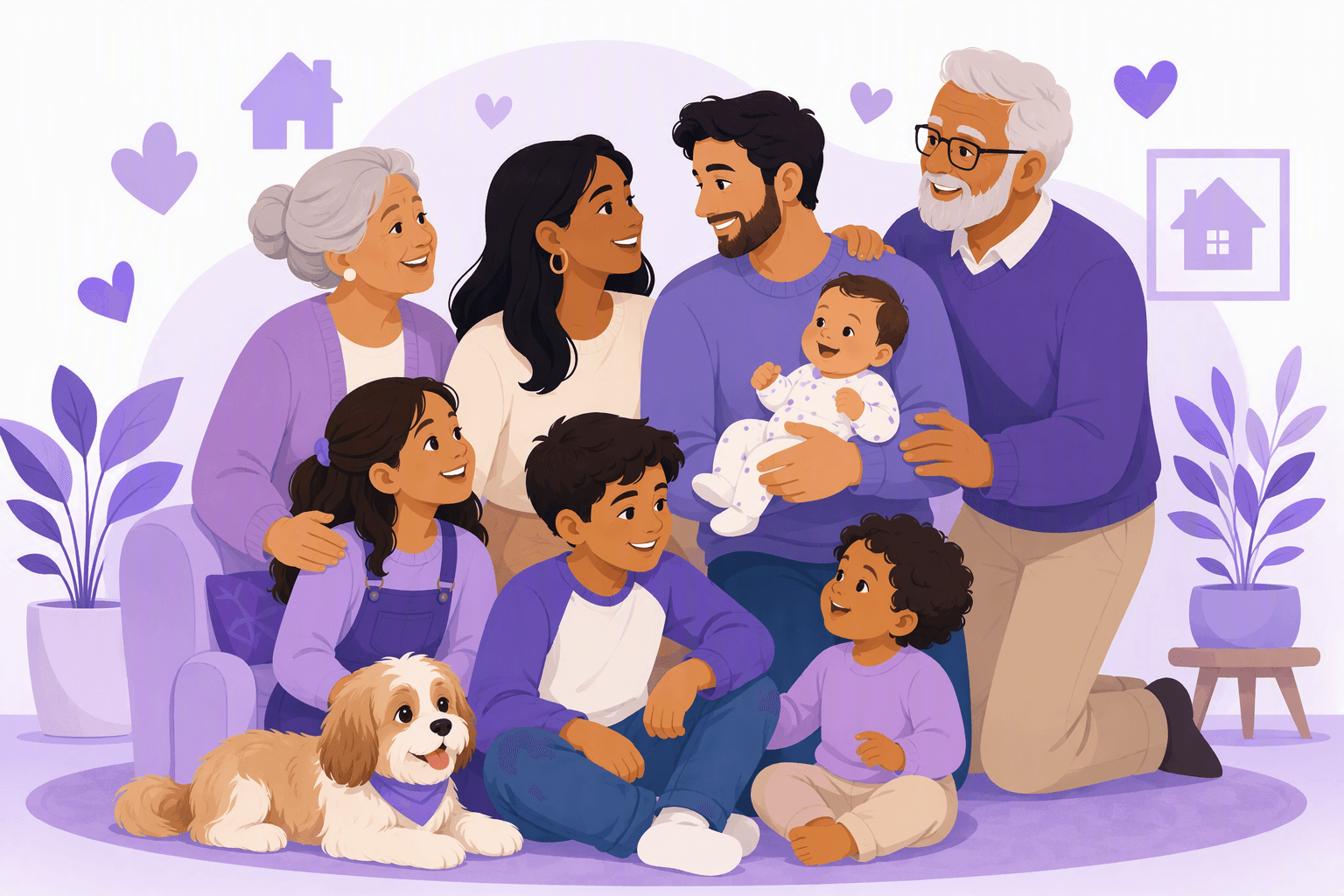
Parents and children
In English, the nuclear family (nuclear family) consists of parents and children. These are the first words worth memorizing, because you hear them every day.
| English | English | Pronunciation | Note |
|---|---|---|---|
| mother | mother / mom (US) / mum (UK) | MUH-thur / mum | Mom = USA, Mum = UK |
| father | father / dad | FAH-thur / dad | |
| son | son | sʌn | |
| daughter | daughter | DAW-tur | |
| parent | parent | PAIR-unt | |
| parents | parents | PAIR-unts | |
| child | child | chyld | |
| children | children | CHIL-drun |
mother and father are the formal versions. You use them in documents, medical records, and respectful contexts. In everyday speech, Americans say mom and dad, and people in the UK often say mum and dad. Both are equally normal, so you will likely hear both in English-language movies and shows.
💡 Mom vs. Mum, the Atlantic difference
Americans use mom (/mɒm/), and people in the UK use mum (/mʌm/). The pronunciation differs too: American mom uses an “o” sound, while British mum uses a short “u” sound. If you watch a British series (for example, Downton Abbey) or an American movie (for example, Home Alone), you will hear the difference.
The pronunciation of son matters: it is /sʌn/, exactly like the word sun. This is a homophone pair (homophones), two different words with the same pronunciation. The pronunciation of daughter is /ˈdɔːtər/, and the “gh” is silent, like in ought, bought, and thought.
Siblings
English sibling vocabulary is neat: there is one neutral word (sibling) and two gendered words (brother, sister). It also distinguishes half-siblings (half-) from twins (twin).
| English | English | Pronunciation | Note |
|---|---|---|---|
| sibling (general) | sibling | SIB-ling | Gender-neutral |
| brother | brother | BRUH-thur | |
| sister | sister | SIS-tur | |
| twin | twin | twin | |
| half-brother | half-brother | HAF-bruh-thur | Same father OR mother |
| half-sister | half-sister | HAF-sis-tur | Same father OR mother |
| older brother | older brother / elder brother | OHL-dur BRUH-thur | Elder = more formal |
| younger sister | younger sister | YUNG-ur SIS-tur |
The word sibling deserves special attention. According to the Oxford English Dictionary, it comes from Old English sibb (relative, kinship). It is very useful in formal, neutral contexts. You see sibling on medical forms, school paperwork, and in statistics. If someone asks, “Are you an only child?”, they mean you have no brothers or sisters. Answer: “No, I have two siblings”, meaning you have two siblings, but the sentence does not say their genders.
Many learners ask about older/elder brother. According to Merriam-Webster, elder sounds slightly more elevated and is used especially in British English. oldest and eldest also exist in parallel: “She is the eldest of three sisters”, meaning she is the oldest of the three sisters.
Grandparents and grandchildren
Grandparent vocabulary is simple and easy to remember. You form the words by adding the prefix grand-. This is the same idea as in French (grand-mère, grand-père).
| English | English | Pronunciation | Note |
|---|---|---|---|
| grandmother | grandmother | GRAN-muh-thur | |
| grandfather | grandfather | GRAN-fah-thur | |
| grandparents | grandparents | GRAN-pair-unts | |
| grandchild (general) | grandchild | GRAN-chyld | |
| grandson | grandson | GRAN-sun | |
| granddaughter | granddaughter | GRAN-daw-tur | |
| grandmother (informal) | grandma / granny / nana | GRAN-mah / GRA-nee / NAH-nah | Informal options |
| grandfather (informal) | grandpa / grandad / pop | GRAN-pah / GRAN-dad / pop | Informal options |
Informal nicknames vary by region and by family. American kids often use grandma and grandpa, while in the UK nan and granddad are very common. Many British and Australian grandmothers are called nana or nan, and grandfathers are often pop or grandad. The Cambridge Dictionary notes that these nicknames often get passed down within families, children often use what their parents used.
Aunts, uncles, cousins
This is the group where English differs the most from many other systems. English does not distinguish between the father’s side and the mother’s side, for either aunts or uncles.
| English | English | Pronunciation | Note |
|---|---|---|---|
| aunt (mother's or father's sister) | aunt | ant (US) / ahnt (UK) | Both sides |
| uncle (mother's or father's brother) | uncle | UNG-kul | Both sides |
| cousin | cousin | KUZ-un | Gender-neutral |
| nephew | nephew | NEF-yoo | |
| niece | niece | nees |
🌍 Why doesn't English have 'father's-side aunt'?
English kinship terminology follows the so-called “Eskimo” system (classified by the anthropologist G. P. Murdock in Social Structure, 1949). In this system, lineal relatives (parents, grandparents, children) are distinguished from collateral relatives (aunts, uncles, cousins), but collateral relatives are treated the same on the mother’s and father’s sides. If you want to be specific, in English you say: “my aunt on my mother's side” or “my father's brother”.
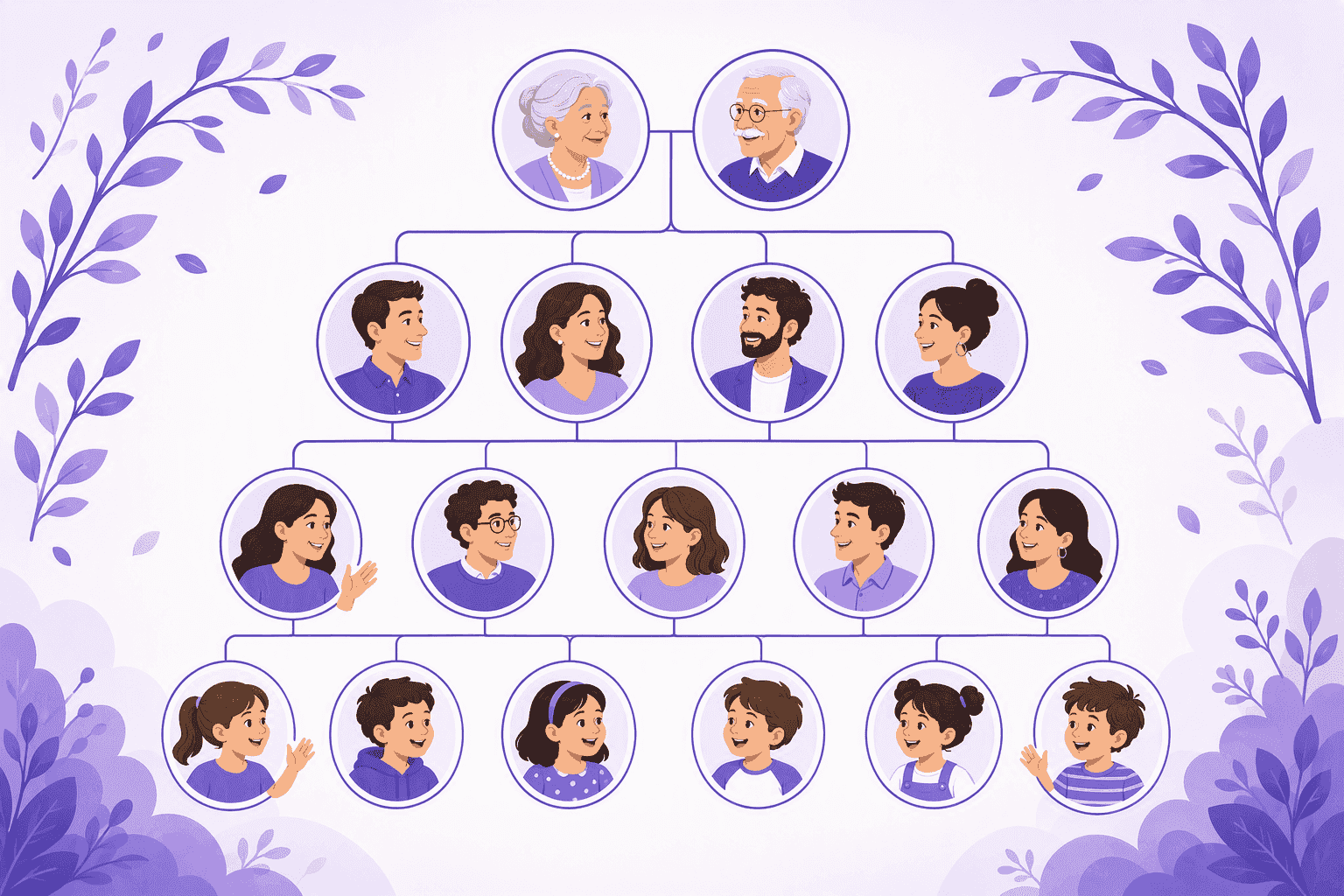
The word cousin is gender-neutral, unlike Spanish (primo/prima) or French (cousin/cousine). In English, it is simply cousin, whether the person is male or female. In the pronunciation of nephew, notice that “ph” sounds like “f”. This comes from Greek, like in phone, photo, and elephant.
Spouses and engagement
Relationship vocabulary in English is very inclusive. There are neutral words (spouse, partner) and gendered words (husband, wife). This matters in modern English communication.
| English | English | Pronunciation | Note |
|---|---|---|---|
| husband | husband | HUZ-bund | |
| wife | wife | wyf | |
| spouse (neutral) | spouse | spows | Formal, gender-neutral |
| fiancé | fiancé | fee-ON-say | Borrowed from French |
| fiancée | fiancée | fee-ON-say | Same pronunciation |
| partner | partner | PART-nur | Gender-neutral, informal |
| boyfriend | boyfriend | BOY-frend | |
| girlfriend | girlfriend | GURL-frend |
💡 The word 'partner', neutral and modern
The English word partner is one of the most useful relationship terms. It is gender-neutral, and it does not define legal status or non-binary identity. Many native English speakers call their long-term partner or even their spouse their partner if they do not want to say husband or wife. In formal documents, spouse is the most common neutral option.
The fiancé and fiancée pair came into English from French. It is a well-known example of English borrowing gender-marked endings too. The pronunciation is the same (fee-ON-say), but in writing fiancée ends with a double e. In everyday English, many people simply write or say my fiancé(e) without marking gender precisely.
In-laws and step-relatives
This is the group where English works in a very systematic way. Two prefixes, in-law and step-, describe almost every family relationship.
| English | Pronunciation |
|---|---|
| mother-in-law | MUH-thur in law |
| father-in-law | FAH-thur in law |
| brother-in-law | BRUH-thur in law |
| sister-in-law | SIS-tur in law |
| son-in-law | sun in law |
| daughter-in-law | DAW-tur in law |
| stepfather | STEP-fah-thur |
| stepmother | STEP-muh-thur |
| stepbrother | STEP-bruh-thur |
| stepsister | STEP-sis-tur |
| stepson | STEP-sun |
| stepdaughter | STEP-daw-tur |
The word in-laws is a hyphenated compound, and you can also use it as a collective noun. “My in-laws are coming for dinner” means your spouse’s parents are coming for dinner. According to a British Council survey, in modern English people increasingly use the simpler collective in-laws instead of mother-in-law / father-in-law in informal contexts.
The prefix step- marks a non-biological relative. The word comes from Old English stēop-, which originally meant “orphaned” or “bereaved”. Today it is neutral, and it describes blended family situations. In the US, the share of blended families reaches about 16% of households according to Pew Research Center, so these words are an important part of everyday vocabulary.
Other relatives
English also labels more distant relatives with a consistent prefix system. The prefix great- shifts the relationship by one generation.
| English | Pronunciation | Note |
|---|---|---|
| great-grandmother | grayt GRAN-muh-thur | |
| great-grandfather | grayt GRAN-fah-thur | |
| second cousin | SEK-und KUZ-un | |
| first cousin once removed | furst KUZ-un wuns ri-MOOVD | Generational distance |
| godfather | GOD-fah-thur | |
| godmother | GOD-muh-thur | |
| godchild | GOD-chyld | |
| blended family / stepfamily | BLEN-did FEM-i-lee |
first cousin once removed is one of the most confusing English family terms. The word removed here means generational distance, not emotional distance. Your cousin’s child is your first cousin once removed, one generation “down”. If you are the child of your parent’s cousin, then your child is also that person’s first cousin once removed, but your cousin’s child is your second cousin. The Oxford English Dictionary has a dedicated entry for this complex terminology.
Useful sentences for the family topic
The table below collects sentences that almost always come up in everyday English conversation, when meeting people, getting to know someone, and in informal situations.
| English | English | Pronunciation |
|---|---|---|
| Do you have any siblings? | Do you have any siblings? | doo yoo hav EN-ee SIB-lingz |
| I have two brothers and one sister. | I have two brothers and one sister. | ay hav too BRUH-thurz and wun SIS-tur |
| I'm an only child. | I'm an only child. | aym un OHN-lee chyld |
| How old is your mother? | How old is your mother? | how ohld iz yor MUH-thur |
| My husband / my wife | My husband / my wife | my HUZ-bund / my wyf |
| My mother-in-law lives in London. | My mother-in-law lives in London. | my MUH-thur-in-law livz in LUN-dun |
| We're a big/small family. | We're a big/small family. | weer uh big/smawl FEM-i-lee |
| My grandparents live in Hungary. | My grandparents live in Hungary. | my GRAN-pair-unts liv in HUNG-gar-ee |
| This is my sister. / This is my brother. | This is my sister. / This is my brother. | this iz my SIS-tur / BRUH-thur |
| There are four of us siblings. | There are four of us siblings. | thair ar for uv us SIB-lingz |
The question “Do you have any siblings?” is one of the most common getting-to-know-you questions in English, especially in English-speaking cultures where family size and structure are normal small talk topics. If you answer “I'm an only child”, that is a complete and natural answer. If you have siblings, you can say: “I have [number] siblings”, or more precisely: “I have a brother and two sisters”.
Practice with real English content
English family vocabulary sticks best in real context, in movies, series, and podcasts. When native speakers talk naturally about their family, you learn everything together: sound, pronunciation, and context.
In the Wordy app, you can watch real English content with interactive subtitles. If you run into an unfamiliar family word, you get the translation, pronunciation, and example sentences with one click. This is how the best English learners study.
If you need movie recommendations, read our article on the best movies to learn English. It includes many titles where the family theme is central. The family drama genre is especially rich in family vocabulary, mothers-in-law, brothers-in-law, stepfathers, and twins show up in scene after scene.
After you learn English family vocabulary, it is worth moving on to other areas of everyday vocabulary too. Visit the Wordy blog for more English vocabulary articles.
Frequently Asked Questions
How do you say the most common family members in English?
What does “sibling” mean in English?
How do you say stepbrother, stepsister, and stepfather in English?
How do you say your spouse’s relatives in English?
What’s the difference between “older brother” and “elder brother”?
Sources & References
- Crystal, David (2019). The Cambridge Encyclopedia of the English Language. Cambridge University Press.
- Merriam-Webster Dictionary (2026). merriam-webster.com.
- Oxford English Dictionary (2025). oed.com.
- British Council (2023). English Language Teaching: Global Research Report.
Start learning with Wordy
Watch real movie clips and build your vocabulary as you go. Free to download.


