Quick Answer
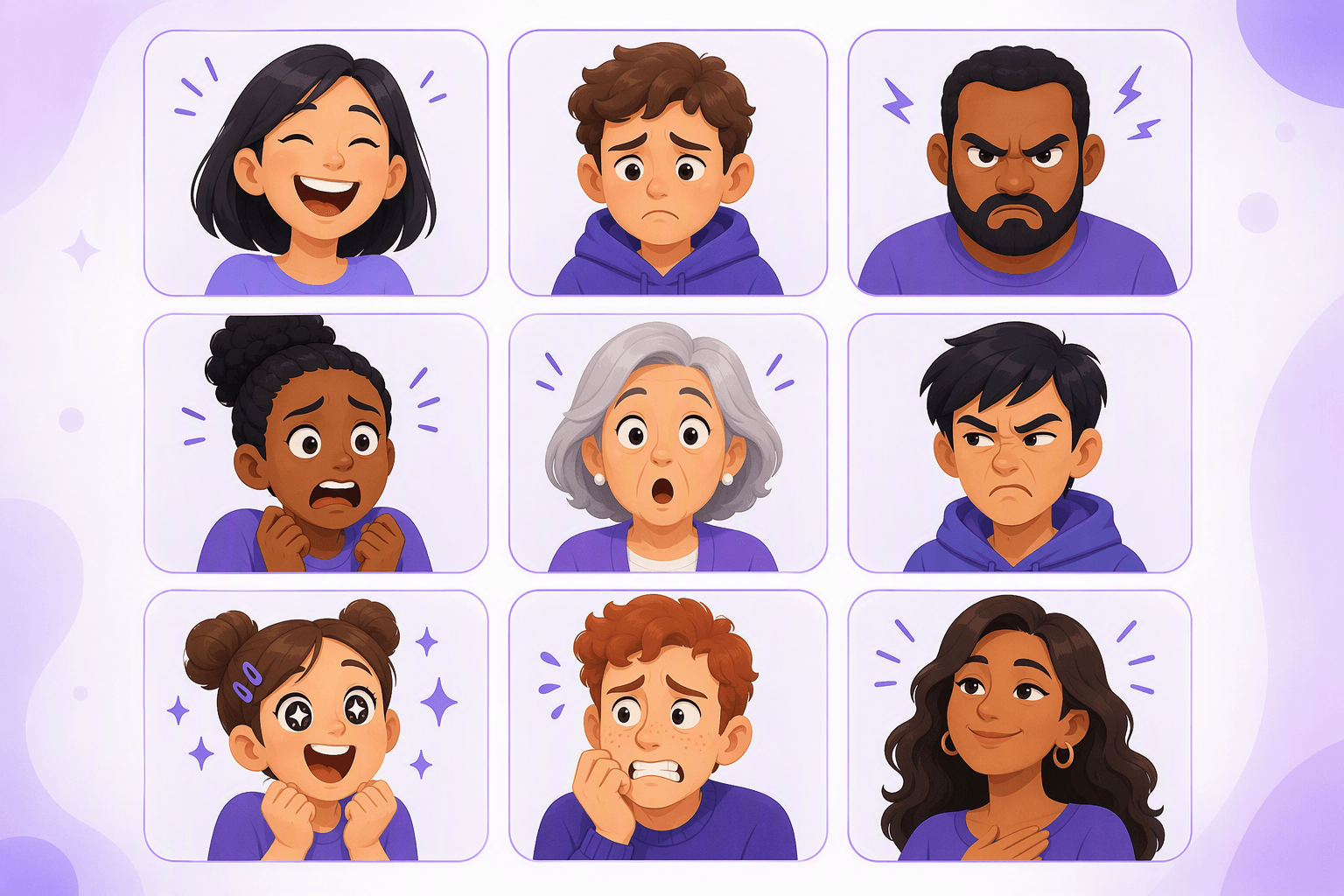
Basic emotion words in English include: happy, sad, angry, scared, excited, nervous, surprised, disappointed. The most natural way to express emotions in English is the pattern “I feel [emotion]” (/aɪ fiːl/).
Mastering English emotional vocabulary is one of the most important steps toward real communication. It is not enough to know that happy means “happy”, natural English also names finer shades of emotion: content (satisfied but not excited), elated (euphorically happy), and joyful (deeply joyful) all describe different emotional states. According to Ethnologue’s 2024 data, nearly 1.5 billion people learn English or use it as a second language, and expressing emotions is one of the first real communication needs.
In English, there are two natural structures for expressing emotions. “I feel [emotion]” (/aɪ fiːl/) is the most general: I feel happy, I feel nervous, I feel proud. The second form is “I'm [emotion]” (/aɪm/): I'm tired, I'm excited, I'm confused. Both are correct and everyday, the only difference is that “I feel” is slightly more emphatic and points to an inner state, while “I'm” is shorter and more neutral.
Psychologist Paul Ekman’s foundational research in 1972 identified six basic emotions that people recognize across cultures, even from facial expressions. These emotions form a shared emotional core for humanity, and English names all of them with simple one or two syllable words.
"Emotions are not just feelings. They are processes that involve appraisal, physiological change, action tendencies, and expression, and every language carves up this emotional space somewhat differently."
(Paul Ekman, Emotions Revealed, Times Books, 2003)
This guide presents 50+ English emotion words by category, with pronunciation, nuance notes, and example sentences. For interactive practice with real English content, visit the Wordy English learning page.

Basic emotions (Ekman’s 6 basic emotions)
Following Paul Ekman’s 1972 research, six basic emotions became a core idea in modern psychology. People recognize them worldwide, regardless of culture, based on facial expressions. English expresses all of them with simple, concise words, these are essential foundations of emotional vocabulary.
| English | Pronunciation | Note |
|---|---|---|
| happy | HAP-ee | General positive feeling |
| sad | sæd | |
| angry | ANG-gree | |
| scared / afraid | skɛrd / uh-FRAYD | |
| disgusted | dis-GUS-tid | |
| surprised | sur-PRYZD |
Scared is more informal and expresses more immediate fear, while afraid is a bit more formal and can describe a longer-lasting state. In disgusted, you can see the root disgust, and disgusting comes from the same root. It is worth noting that surprised is neutral on its own, it can be positive (I'm surprised, this is amazing!) or negative (I'm surprised he said that).
Positive emotions
English has rich vocabulary for shading positive feelings. Happy is the broadest, most general word, but natural English communication often uses more precise synonyms too.
| English | Pronunciation | Note |
|---|---|---|
| excited | ik-SY-tid | Anticipation and energy |
| joyful | JOY-ful | Deeper, lasting joy |
| proud | praʊd | |
| grateful | GRAYT-ful | |
| content | kun-TENT | Calm satisfaction |
| relieved | rih-LEEVD | |
| hopeful | HOHP-ful | |
| enthusiastic | in-thyoo-zee-AS-tik | |
| delighted | dih-LY-tid | |
| elated | ih-LAY-tid | Very intense happiness |
💡 Happy vs. excited vs. joyful, three different kinds of happiness
These three common positive emotion words describe different states. Happy (/HAP-ee/) is general well-being and the broadest word. Excited (/ik-SY-tid/) means forward-looking excitement, energy you feel before an anticipated event: I'm excited about the trip (I’m excited about the trip). Joyful (/JOY-ful/) is deeper and fuller, and it sounds slightly more formal, it is common in religious and literary texts too. If a native speaker says I'm elated, it is close to euphoria: getting an A on an exam, receiving an offer for a dream job.
Grateful and thankful are used almost as synonyms, but there is a subtle difference. Grateful is deeper and more emotionally loaded, it expresses genuine heartfelt gratitude. Thankful is a bit more neutral and often tied to a specific event: I'm thankful the rain stopped (I’m thankful the rain stopped). Elated and delighted both express strong joy, but delighted can also carry pleasant surprise: I'm delighted to meet you (I’m delighted to meet you).
Negative emotions
Negative emotional vocabulary in English is especially detailed. Nervous and anxious, disappointed and frustrated, lonely and ashamed all describe different emotional states, and the distinction matters for precise communication.
| English | Pronunciation | Note |
|---|---|---|
| nervous | NUR-vus | Tied to a specific event |
| anxious | ANK-shus | More general worry |
| worried | WUR-eed | |
| frustrated | FRUS-tray-tid | |
| disappointed | dis-uh-POIN-tid | |
| lonely | LOHN-lee | |
| jealous | JEL-us | |
| embarrassed | im-BAIR-ust | |
| guilty | GIL-tee | |
| ashamed | uh-SHAYMD | |
| bored | bɔːrd | |
| confused | kun-FYOOZD |
💡 Nervous vs. anxious, the key difference
These two words are one of the most common sources of misunderstandings. Nervous (/NUR-vus/) means short-term nervousness tied to a specific event: I'm nervous about the job interview (I’m nervous about the job interview). Once the event ends, the feeling usually passes. Anxious (/ANK-shus/) expresses more general, longer-lasting, and more diffuse worry that may not have a specific object: I've been feeling anxious lately (I’ve been feeling anxious lately). Anxiety also appears in English as a clinical term, as the name for anxiety disorders.
Guilty and ashamed also carry a nuanced difference. Guilty relates to a specific action: I feel guilty about lying (I feel guilty about lying). Ashamed affects self-image more deeply: I'm ashamed of myself (I’m ashamed of myself). Lonely and alone are not synonyms: you can be alone without feeling lonely, and the other way around, you can feel lonely in a crowd.
The fear scale: from being scared to being terrified
English offers extremely detailed vocabulary for describing different intensities of fear. From mild discomfort to complete freezing, you have a full scale, and native speakers use these nuances intentionally.
| English | Pronunciation | Note |
|---|---|---|
| uneasy | un-EE-zee | Mildest level |
| nervous | NUR-vus | |
| scared | skɛrd | General fear |
| frightened | FRY-tend | |
| terrified | TEHR-ih-fyd | Very intense |
| petrified | PET-rih-fyd | Strongest level |
The etymology of petrified is especially vivid: it comes from the Greek root petra (stone), literally “turned to stone”, and it describes the moment when someone completely freezes from fear. According to Merriam-Webster, the word entered English via Latin in the 16th century. In English, this scale also appears in sentences, from He was a little uneasy about the meeting (He felt a bit uneasy about the meeting) all the way to She was absolutely petrified (She was completely petrified).
Surprise and amazement
Surprise in English also activates a whole vocabulary set, from pleasantly stunned to a shocked jolt. Surprised is the neutral base word, but words below and above it give a more precise picture of intensity.
| English | Pronunciation | Note |
|---|---|---|
| surprised | sur-PRYZD | Neutral, can be positive/negative |
| astonished | uh-STON-isht | |
| amazed | uh-MAYZD | More positive |
| shocked | ʃɒkt | Negative surprise |
| stunned | stʌnd | |
| speechless | SPEECH-lus |
There is a subtle difference between amazed and astonished. Amazed carries more positive admiration: I'm amazed by her talent (I’m amazed by her talent). Astonished is more like plain astonishment, positive or negative: I was astonished to hear the news (I was astonished to hear the news). Shocked, by contrast, almost always signals negative surprise, in response to something unexpected and unpleasant.
How do we express our emotions?
In English, there are a few basic structures for expressing emotions that you should learn naturally.
“I feel…” , The most natural, most neutral form:
- I feel happy. (I feel happy.)
- I feel a bit nervous. (I feel a bit nervous.)
- I don't feel well. (I don't feel well.)
“I'm feeling…” , More emphatic and more momentary:
- I'm feeling really excited about tomorrow. (I'm really excited about tomorrow.)
- I'm feeling overwhelmed right now. (I feel overwhelmed right now.)
“I'm so…” , Emotional emphasis:
- I'm so proud of you! (I'm so proud of you!)
- I'm so disappointed. (I'm so disappointed.)
Body-based expressions , In English, people often express emotions with body metaphors:
- My heart sank. (My heart sank, meaning I received upsetting news.)
- I was over the moon. (I was over the moon, meaning I was extremely happy.)
- I had butterflies in my stomach. (I had butterflies in my stomach, meaning I felt nervous.)
- I was on edge. (I was on edge, meaning I felt tense and nervous.)
Emotional expressions in sentences
The table below shows the most common emotions through natural English sentences. Notice how “I feel” and “I'm” alternate.
| English | English sentence | Pronunciation |
|---|---|---|
| I'm happy. | I'm happy. | aɪm HAP-ee |
| I'm so excited! | I'm so excited! | aɪm soʊ ik-SY-tid |
| I'm nervous about the exam. | I'm nervous about the exam. | aɪm NUR-vus uh-baʊt ðə ɪɡˈzæm |
| I'm scared of the dark. | I'm scared of the dark. | aɪm skɛrd əv ðə dɑːrk |
| I'm proud of you. | I'm proud of you. | aɪm praʊd əv juː |
| I feel really sad. | I feel really sad. | aɪ fiːl ˈrɪəli sæd |
| I'm grateful for your help. | I'm grateful for your help. | aɪm GRAYT-ful fər jɔːr help |
| I'm so frustrated. | I'm so frustrated. | aɪm soʊ FRUS-tray-tid |
| I'm relieved. | I'm relieved. | aɪm rih-LEEVD |
| I feel confused. | I feel confused. | aɪ fiːl kun-FYOOZD |
The structures scared of and afraid of both take a preposition: scared of spiders, afraid of flying. It is worth noting that in English you do not say “I'm boring” when you mean you feel bored, you say “I'm bored”. Boring describes the thing or person (This lecture is boring), while bored describes the person’s feeling (I'm bored). This difference, interesting vs. interested, exciting vs. excited, tiring vs. tired, is one of the most common sources of misunderstandings.
Emotions in English-speaking culture
🌍 British 'stiff upper lip' vs. American emotional expressiveness
English emotional vocabulary is rich and nuanced, but the cultural code for using these words is not the same across the English-speaking world. In British culture, people have traditionally valued emotional restraint, often described with the phrase “stiff upper lip”: showing strong emotions is not considered appropriate, and fine can work as an answer in almost any situation. A British “I'm a bit upset” can actually mean serious emotional pain. American communication style, by contrast, is much more expressive: open, verbal emotional expression is expected and welcomed, and “I'm so excited!” and “I love this!” are part of everyday conversation. If you communicate with a British partner or colleague, it helps to learn to read understatement, while American-influenced English often uses direct and enthusiastic emotional expression.
The difference between British and American emotional communication is not only a cultural curiosity, it can also be a real communication challenge. British Council’s 2023 English Language Teaching research found that emotional vocabulary and cultural pragmatics are among the most frequently mentioned difficulties for non-native English learners, especially judging the right intensity for emotions.
Practice with real English content
Emotional vocabulary is the area where real context matters most. A dictionary tells you that elated means “very happy”, but real learning happens when you hear a character say it in a movie scene, see their body language, hear their tone, and feel the weight of the situation.
English movies and series are especially effective for learning emotional vocabulary, because emotional expression, facial expressions, and dialogue together give a complete picture of how a word is really used.
Wordy lets you process English content with interactive subtitles. When an emotion word appears in dialogue, whether it is nervous, elated, or petrified, you can tap it and instantly see pronunciation, meaning, and context. This works much better than memorizing lists, emotions stick through real tone, facial expression, and situation, not just as a translation.
Frequently Asked Questions
How do you say the most important emotions in English?
How do you say “how are you feeling?” in English?
What’s the difference between “nervous” and “anxious” in English?
How do you say “I’m scared” in English?
How do you say “I’m surprised” in English?
Sources & References
- Crystal, David (2019). The Cambridge Encyclopedia of the English Language. Cambridge University Press.
- Ekman, Paul (2003). Emotions Revealed. Times Books.
- Merriam-Webster Dictionary (2026). merriam-webster.com.
- British Council (2023). English Language Teaching: Global Research Report.
Start learning with Wordy
Watch real movie clips and build your vocabulary as you go. Free to download.


