Quick Answer
Basic animal names in English: dog, cat, horse, cow, bird, fish. Learn animal sounds in English too: a dog barks, a cat meows, a cow moos. “Sheep” is the same in singular and plural, one of the most common zero plurals.
Animal names show up almost right away when you learn English, in children’s books, movies, nature documentaries, and even weather sayings. According to Ethnologue’s 2024 data, nearly 1.5 billion people learn English or use it as a second language, and animal vocabulary is one of the first topics every textbook returns to.
Two things make English animal vocabulary especially interesting. The first is animal sounds: in English, many animals have their own specific verb for the sound they make, a dog barks, a cat meows, a cow moos, a pig oinks. These verbs appear constantly in native content, and they are hard to learn from a dictionary. The second is the system of irregular plurals: sheep looks the same in singular and plural (one sheep, two sheep, there is no sheeps), and the same is true for deer and for most uses of fish.
"English animal vocabulary is particularly rich in onomatopoeia, words that imitate the sounds animals make. These vary significantly between languages, revealing how culturally constructed our perception of animal sounds really is."
(David Crystal, The Cambridge Encyclopedia of the English Language, Cambridge University Press, 2019)
This guide shows 50+ English animal names by category, with pronunciation, the animal sound system, and animal idioms that are part of everyday English-speaking culture. For continuous, interactive practice, visit Wordy’s English learning page.
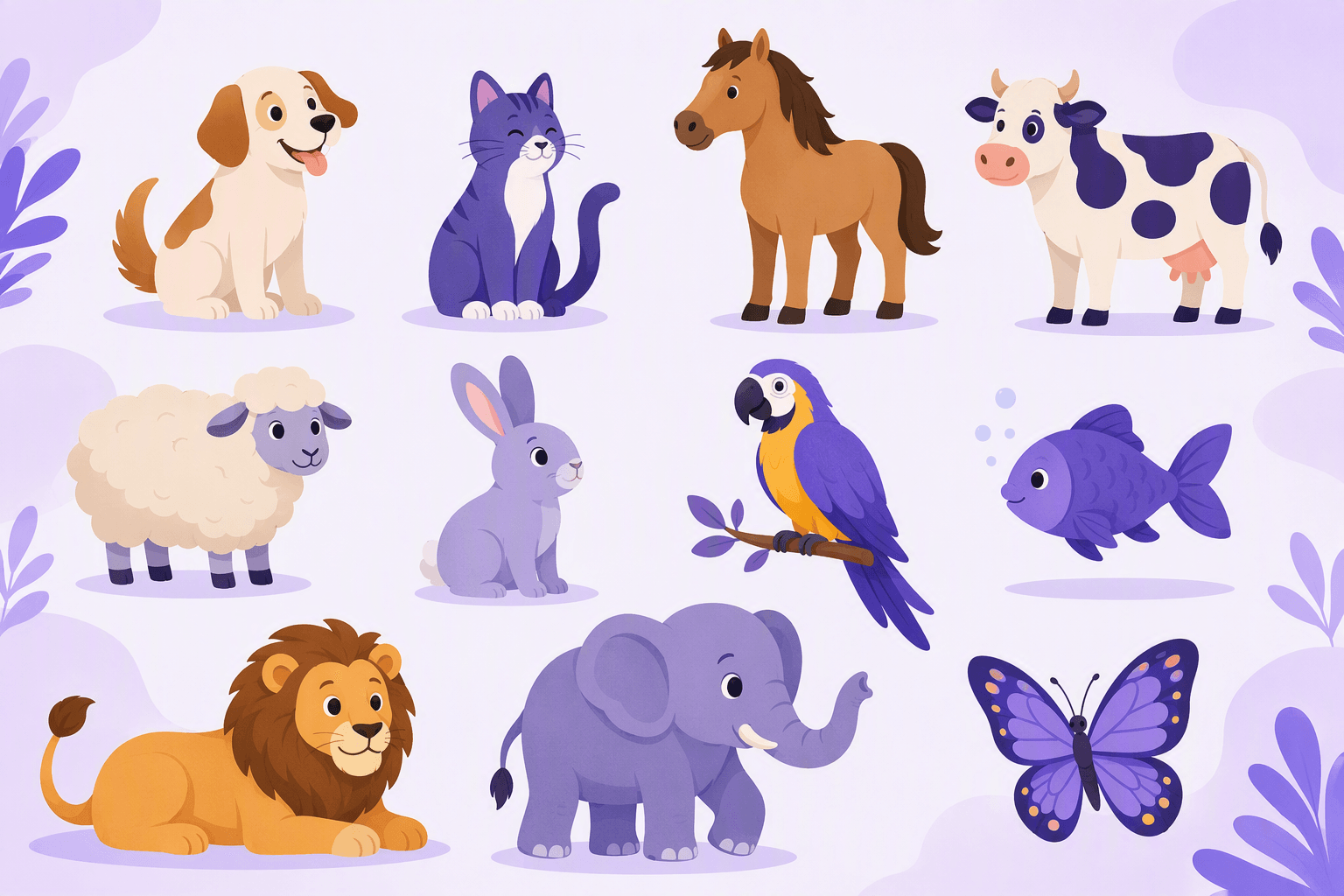
Pets
The word pet is the general English term for a household animal, as opposed to a wild animal or a farm animal. There are also small differences between British English and American English in this topic: in the United Kingdom, small parrot types are usually called budgerigar or budgie, while in American English the same bird is most often called a parakeet.
| English | Pronunciation | Note |
|---|---|---|
| dog | dɒɡ | Common nicknames: doggy, pup |
| cat | kæt | Common nicknames: kitty, kitten |
| fish | fɪʃ | Plural: fish (usually) or fishes (for species) |
| rabbit | RÆB-ɪt | |
| hamster | HÆM-stər | |
| guinea pig | GIN-ee pɪɡ | It is not a pig, but that is the English name |
| parrot | PÆR-ət | |
| turtle | TUR-tl | UK: tortoise (land), turtle (water) |
| goldfish | GOLD-fɪʃ | |
| budgie / parakeet | BUJ-ee / PÆR-ə-kiːt | UK: budgie, US: parakeet |
💡 How to use the word 'pet'
As a noun, pet means a household animal (I have two pets, I have two pets), but it is also used as an adjective: pet dog (a pet dog), pet shop (a pet shop), pet name (a nickname, literally a “pet name”, a term of endearment). The phrase It's my pet hate means the opposite, something someone especially dislikes. Watch the context.
In British English, a land tortoise is called a tortoise (/TOR-təs/), and a water turtle is called a turtle (/TUR-tl/). In American English, turtle is the more common word for both. This difference is small, but important when you read British content (BBC nature documentaries, British children’s books).
Farm animals
Farm animals in English are farm animals, and this group includes one of the most popular challenges in English morphology: irregular plurals and male and female distinctions. According to a 2023 study by the British Council, the irregular plural of sheep (sheep → sheep) is one of the most common mistakes among intermediate English learners.
| English | Pronunciation | Note |
|---|---|---|
| cow | kaʊ | Male: bull, young: calf |
| horse | hɔːrs | Male: stallion, female: mare, young: foal |
| pig | pɪɡ | Male: boar, female: sow, young: piglet |
| sheep / lamb | ʃiːp / læm | Sheep = adult, lamb = young |
| chicken / hen | CHIK-ɪn / hɛn | Male: rooster, young: chick |
| goat | ɡoʊt | Young: kid |
| duck | dʌk | Female: hen, male: drake, young: duckling |
| turkey | TUR-kee | |
| donkey | DONG-kee | Informal: ass, young: foal |
| rooster | ROO-stər | In British English: cock |
The irregular plural sheep → sheep in English is a so-called zero plural: the singular and plural forms are the same. The same is true for deer → deer and, in most cases, fish → fish. In contrast, chicken has a regular plural (chickens), but in a food context chicken is uncountable: Would you like some chicken? (meaning chicken meat).
Animal sounds in English
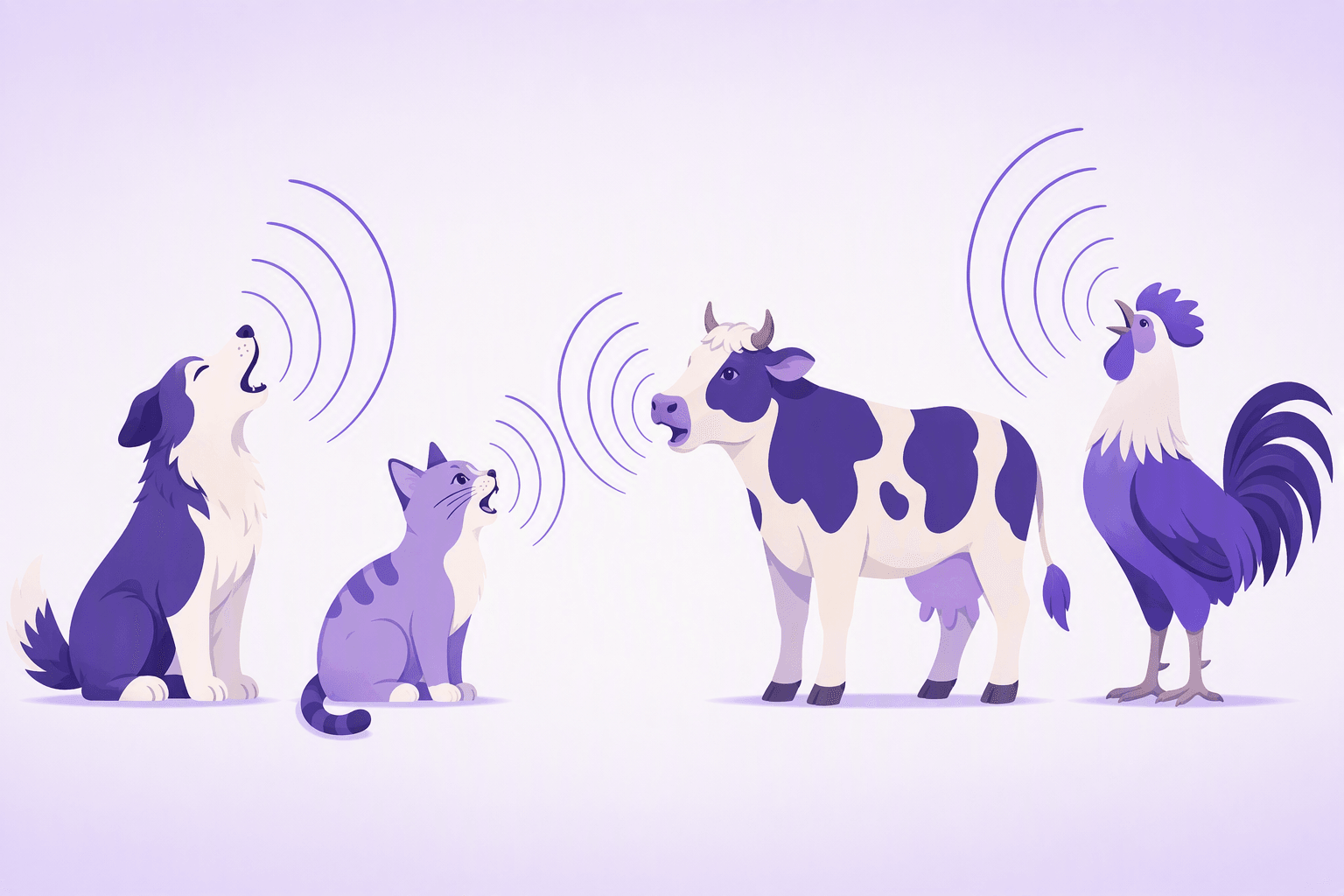
Animal sound words are one of the clearest areas where languages differ radically. In English, a dog goes woof or bark, a cow goes moo, and a rooster goes cock-a-doodle-doo. These onomatopoeic words do not translate, you need to learn them.
| English | English | Pronunciation | Note |
|---|---|---|---|
| dog | dog, barks / woofs | bɑːrks / wʊfs | Verb: to bark, sound: woof, woof! |
| cat | cat, meows / purrs | miˈaʊz / pɜːrz | Meow: meows, purr: purrs |
| cow | cow, moos | muːz | Verb: to moo, sound: moo! |
| pig | pig, oinks | ɔɪŋks | Verb: to oink, sound: oink, oink! |
| horse | horse, neighs | neɪz | Verb: to neigh, sound: neigh! |
| sheep / lamb | sheep, bleats | bliːts | Verb: to bleat, sound: baa! |
| rooster | rooster, crows | kroʊz | Verb: to crow, sound: cock-a-doodle-doo! |
| frog | frog, croaks | kroʊks | Verb: to croak, sound: ribbit! |
| bee | bee, buzzes | bʌzɪz | Verb: to buzz, sound: buzz! |
| lion | lion, roars | rɔːrz | Verb: to roar, sound: roar! |
🌍 Why do animal sounds differ across languages?
“Translating” animal sounds from one language to another is one of the most fun proofs that onomatopoeia is strongly shaped by culture. For example, a dog is woof in English, wan-wan in Japanese, ouaf-ouaf in French, and gav-gav in Russian. In every case, the human brain processes the same real sound, but each culture encodes it differently in its own phonological system. The Merriam-Webster dictionary treats animal sounds as a separate lexical category, which also shows how important they are in English.
Wild animals, Africa and Asia
In English, the names of African and Asian wild animals often have Latin or Greek roots, and many of them also appear in similar forms in other languages. elephant (/EL-ɪ-fənt/) comes from Greek elephas, and rhinoceros (/raɪ-NOS-ər-əs/) literally means “nose horn” in Greek (rhino = nose, keras = horn). These etymologies help you remember the words.
| English | Pronunciation | Note |
|---|---|---|
| lion | LAɪ-ən | Female: lioness, young: cub |
| elephant | EL-ɪ-fənt | There are African and Asian species |
| tiger | TAɪ-ɡər | |
| giraffe | dʒɪ-RÆF | |
| zebra | ZEE-brə (US) / ZEB-rə (UK) | British and American pronunciation differs |
| gorilla | ɡə-RIL-ə | |
| cheetah | CHEE-tə | |
| rhinoceros / rhino | raɪ-NOS-ər-əs / RAɪ-noʊ | Common short form: rhino |
| hippopotamus / hippo | hɪp-ə-POT-ə-məs / HIP-oʊ | Common short form: hippo |
| crocodile | KROK-ə-daɪl | Alligators and crocodiles are different species |
The pronunciation of zebra is one of the most noticeable British vs American differences in animal names. Americans say ZEE-brə, and Brits say ZEB-rə, as if they were different words. If you watch a BBC nature documentary with David Attenborough, you will hear the British pronunciation. If you watch an American kids’ movie, you will hear the American one. Both are accepted, but it is worth knowing the difference.
Wild animals, Europe and America
Vocabulary for European and North American wildlife is especially useful if you watch English nature documentaries or travel to English-speaking countries.
| English | Pronunciation | Note |
|---|---|---|
| bear | bɛr | Grizzly, polar bear, black bear, by species |
| wolf | wʊlf | Plural: wolves, not wolfs |
| fox | fɒks | Plural: foxes |
| deer | dɪr | Plural: deer, not deers (zero plural) |
| hare | hɛr | Hare = hare, rabbit = rabbit |
| eagle | EE-ɡl | |
| owl | aʊl | |
| snake | sneɪk | |
| frog | frɒɡ | Toad: toad, a different species |
| bat | bæt |
There is an important difference between hare and rabbit: a hare (/hɛr/) is a wild hare that is larger, has longer ears, and lives outdoors. A rabbit (/RÆB-ɪt/) is smaller, has shorter ears, can be kept as a pet, and often lives in smaller groups in fields. The March Hare became famous in English from Lewis Carroll’s Alice’s Adventures in Wonderland, a hare character that acts wildly in March. Rabbit is also known from the phrase rabbit hole, which people use online for getting lost in endless information.
Sea animals
Vocabulary for ocean and sea animals became widely known through English nature documentaries, especially the BBC series Blue Planet. According to IUCN Red List data, about one third of ocean species face some level of threat, so these words appear more and more often in news and environmental articles.
| English | Pronunciation | Note |
|---|---|---|
| fish | fɪʃ | Plural: fish (usually), fishes (for species) |
| shark | ʃɑːrk | |
| whale | weɪl | Blue whale, humpback whale, species |
| dolphin | DOL-fɪn | |
| octopus | OK-tə-pəs | Plural: octopuses (standard), octopi (Latin-style) |
| crab | kræb | |
| lobster | LOB-stər | |
| seal | siːl | |
| jellyfish | JEL-ee-fɪʃ | |
| seahorse | SEE-hɔːrs |
English has had a decades-long debate about the plural of octopus. Merriam-Webster says octopuses is the fully regular and recommended form, octopi is a Latin-style spelling (and it is technically based on a wrong etymology, since octopus is Greek, not Latin), and octopodes is the Greek-correct form that almost nobody uses. In everyday English, octopuses is the most common and safest choice.
Birds
Birds in English are birds, and English is one of the languages where the word bird can mean a bird in general and, in some contexts (informal British slang), a woman. This second use has become less common and less accepted in recent decades.
| English | Pronunciation | Note |
|---|---|---|
| eagle | EE-ɡl | |
| owl | aʊl | A symbol of wisdom in English-speaking culture |
| parrot | PÆR-ət | To imitate: to parrot |
| penguin | PENG-ɡwɪn | |
| flamingo | flə-MING-ɡoʊ | |
| crow | kroʊ | Raven: raven, larger and completely black |
| swan | swɒn | |
| sparrow | SPÆR-oʊ |
The word parrot also works as a verb in English: to parrot something means to repeat it without understanding it (She just parroted everything the teacher said, she repeated exactly what the teacher said). Owl is a symbol of wisdom and the night in both British and American folklore, from Hedwig the snowy owl in the Harry Potter series to Owl in Winnie-the-Pooh.
Insects and small creatures
English distinguishes between insects (insects, six-legged arthropods) and bugs (a looser everyday word that can refer to insects, spiders, and other small creatures). Bug is more informal and broader, while insect is scientifically precise.
| English | Pronunciation | Note |
|---|---|---|
| bee | biː | Honeybee: honeybee, bumblebee: bumblebee |
| butterfly | BUT-ər-flaɪ | |
| ant | ænt | |
| spider | SPAɪ-dər | A spider is not an insect (8 legs), but people call it a 'bug' |
| fly | flaɪ | |
| mosquito | mə-SKEE-toʊ | |
| worm | wɜːrm | |
| ladybug / ladybird | LAY-dee-bʌɡ / LAY-dee-bɜːrd | US: ladybug, UK: ladybird |
💡 Ladybug (USA) vs ladybird (UK)
The name of the ladybug is one of the best examples of British vs American vocabulary differences. In the United States, it is ladybug. In the United Kingdom, it is ladybird. Both refer to the same bright red beetle with black spots. The prefix lady comes from an association with the Virgin Mary (in medieval folk belief, the red color referred to Mary’s cloak), and the bug or bird ending varies by region. If you watch a British BBC documentary, you will hear ladybird. If you watch an American nature show, you will hear ladybug.
Animal idioms in English
Animal idioms are one of the most productive vocabulary areas in English. According to the Cambridge Dictionary, English has more than 200 common animal idioms in everyday speech, and without them, natural native content, especially journalistic and literary English, can be hard to understand.
„It's raining cats and dogs" Literally: it is raining cats and dogs. Meaning: it is raining very heavily. Its exact origin is uncertain, but it goes back to the 17th century. The first known written example appears in a 1651 edition of a proverb collection. The forecast says it's going to rain cats and dogs this weekend, The forecast says it will pour this weekend.
„The elephant in the room" Literally: the elephant in the room. Meaning: the obvious problem or awkward fact that everyone knows about, but nobody dares to mention. Nobody mentioned the budget cuts, it was the elephant in the room, Nobody mentioned the budget cuts, it was the elephant in the room.
„A wolf in sheep's clothing" Literally: a wolf in sheep’s clothing. Meaning: a dangerous or evil person who pretends to be innocent. The phrase comes from the Bible (Matthew 7:15). Be careful, he seems friendly, but he might be a wolf in sheep's clothing, Be careful, he seems friendly, but he might be a wolf in sheep’s clothing.
„Birds of a feather (flock together)" Literally: birds of one feather (flock together). Meaning: similar people stick together. Those two are always together, birds of a feather, I suppose, Those two are always together, birds of a feather, I suppose.
„To let the cat out of the bag" Literally: to let the cat out of the bag. Meaning: to reveal a secret by accident. She let the cat out of the bag about the surprise party, She accidentally revealed the secret about the surprise party.
„To kill two birds with one stone" Literally: to kill two birds with one stone. Meaning: to do two things with one action. I'll stop by the post office on the way to the gym, kill two birds with one stone, I will stop by the post office on the way to the gym, kill two birds with one stone.
Practice with real English content
Animal vocabulary is especially easy to learn from authentic English content. BBC nature documentaries (Planet Earth, Blue Planet, Our Planet on Netflix) with David Attenborough’s narration are one of the best sources. They present these animal names and related vocabulary in natural, clearly pronounced British English.
In our list of the best English movies and series, you will find content where animal vocabulary, from pets to wild animals, appears in a natural context. Animated movies (Finding Nemo, The Lion King, Zootopia) offer basic vocabulary, while nature documentaries and documentaries offer more advanced vocabulary.
Wordy helps you process English content with interactive subtitles: if you hear an animal name and do not understand it, you can learn the pronunciation, meaning, and context with one tap. This way, animal vocabulary sticks in your memory through real English sentences, not isolated word lists.
Frequently Asked Questions
How do you say the most common pets in English?
How do you say animal sounds in English?
What is the difference between “sheep” and “lamb” in English?
How do you say male and female wild animals in English?
What are irregular animal plurals in English?
Sources & References
- Crystal, David (2019). The Cambridge Encyclopedia of the English Language. Cambridge University Press.
- Merriam-Webster Dictionary (2026). merriam-webster.com.
- Oxford English Dictionary (2025). oed.com, animal entries.
- British Council (2023). English Language Teaching: Global Research Report.
Start learning with Wordy
Watch real movie clips and build your vocabulary as you go. Free to download.


