Bereit zu lernen?
Wahle eine Sprache zum Starten!
Kurze Antwort
Englisch ist die Sprache des Reisens, an Flughäfen, in Hotels und Restaurants weltweit kannst du dich auf Englisch verständigen. Wichtige Sätze sind: „Where is...?“ (/wɛr ɪz/), „How much does this cost?“ (/haʊ mʌtʃ dʌz ðɪs kɒst/), „Could I have the bill, please?“ (/kʊd aɪ hæv ðə bɪl/) und „I need help, please.“ (/aɪ niːd hɛlp/).
Die kurze Antwort
Englisch ist die globale Reisesprache. Wenn du einen Satz auf Englisch kannst, kannst du fast überall kommunizieren. Der wichtigste ist: "Could you help me, please?" (/kʊd juː hɛlp miː pliːz/). Er zeigt sofort, dass du Hilfe brauchst und höflich bist, am Flughafen, im Hotel oder auf der Straße.
Laut Ethnologue 2024 nutzen fast 1,5 Milliarden Menschen Englisch für die tägliche Kommunikation. Das macht es zur weltweit am weitesten verbreiteten Lingua franca. Der Linguist David Crystal (The Cambridge Encyclopedia of the English Language, Cambridge University Press, 2019) sagt, Englisch sei die einzige Sprache, die auf jedem Kontinent offiziell ist oder weit verbreitet genutzt wird. Es ist außerdem die De-facto-Standardsprache in der Luftfahrt, im Tourismus und in der Hotelbranche.
"English is not just a language, it is the code that the world’s travelers use to communicate with each other. Anyone who learns a few polite phrases becomes part of this global conversation right away."
(British Council, English Language Teaching: Global Research Report, 2023)
Dieser Guide enthält 50+ wichtige englische Reisephrasen, nach Situationen gruppiert: Flughafen und Zoll, Hotel, Restaurant, Transport, Shopping und Notfälle. Zu jedem Satz bekommst du Aussprache, einen echten Beispielsatz und kulturellen Kontext. So weißt du, wann und wie du ihn benutzt.
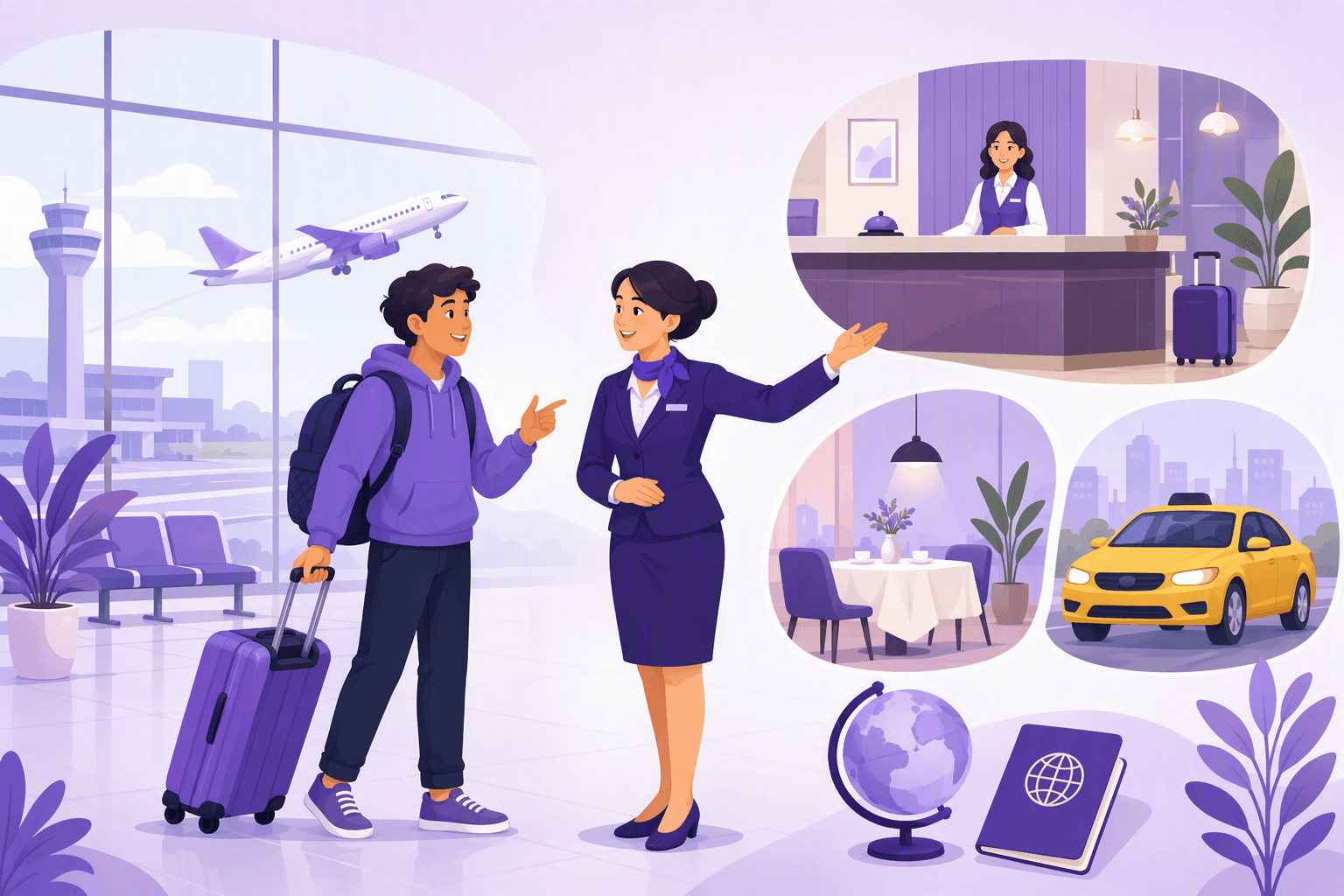
Kurzübersicht: die 12 wichtigsten englischen Reisephrasen
| Englisch | Aussprache | Formalität |
|---|---|---|
| Where is...? | /wɛr ɪz/ | polite |
| How much does this cost? | /haʊ mʌtʃ dʌz ðɪs kɒst/ | polite |
| Could you help me, please? | /kʊd juː hɛlp miː pliːz/ | polite |
| I have a reservation | /aɪ hæv ə rɛzərˈveɪʃən/ | formal |
| Could I have the bill, please? | /kʊd aɪ hæv ðə bɪl pliːz/ | polite |
| I don't understand | /aɪ doʊnt ʌndərˈstænd/ | polite |
| Please speak more slowly | /pliːz spiːk mɔːr ˈsloʊli/ | polite |
| I need a doctor | /aɪ niːd ə ˈdɒktər/ | polite |
| Help! | /hɛlp/ | casual |
| Thank you | /θæŋk juː/ | polite |
| Please | /pliːz/ | polite |
| Excuse me | /ɪkˈskjuːz miː/ | polite |
Flughafen und Zoll
Moderne Flughäfen haben fast überall englische Schilder. Trotzdem machen dich ein paar Schlüsselsätze unabhängiger. Das ist besonders wichtig bei Zoll und Einreise, wo Beamte oft Fragen auf Englisch stellen. Der British Council sagt, Englisch sei die wichtigste Kommunikationssprache an allen großen internationalen Flughäfen.
Where is the gate?
//wɛr ɪz ðə ɡeɪt//
Wörtliche Bedeutung: Where is the gate?
“Excuse me, where is gate B12?”
Excuse me, where is gate B12?
At the airport, 'gate' means the boarding gate, not the entrance. If you are lost, ask the staff. Airport workers are used to international passengers.
Die Struktur Where is...? ist die flexibelste Art, auf Englisch nach dem Weg zu fragen. Tausche einfach den Ort aus: Where is the baggage claim?, Where is the customs?, Where is the exit?.
Is this seat taken?
//ɪz ðɪs siːt ˈteɪkən//
Wörtliche Bedeutung: Is this seat taken?
“Excuse me, is this seat taken? Can I sit here?”
Excuse me, is this seat taken? Can I sit here?
You can use this in a waiting area, on a bus, or on a plane. If the seat is free, the answer is: 'No, go ahead.' If it is taken: 'Yes, sorry.'
Do you have anything to declare?
//duː juː hæv ˈɛniθɪŋ tə dɪˈklɛr//
Wörtliche Bedeutung: Do you have anything to declare?
“Do you have anything to declare?, No, just personal items.”
Do you have anything to declare?, No, just personal items.
Customs officers ask this question. A standard answer is: 'No, just personal belongings.' Stay calm and brief. Customs officers ask routine questions.
💡 Nützliche Flughafenwörter
Ein paar wichtige Begriffe, die du auf Schildern siehst: Departures, Arrivals, Boarding, Gate, Baggage claim, Customs, Immigration, Transit. Du musst diese nicht sagen. Du musst sie nur erkennen, dann bewegst du dich sicherer.
Hotel und Unterkunft
Englischsprachiges Hotelpersonal, egal ob in London, New York oder Dubai, ist internationale Gäste gewohnt und hilft gern. Der Check-in läuft fast überall gleich ab. Du nennst deinen Namen, zeigst deinen Reisepass und bekommst deinen Schlüssel.
I have a reservation
//aɪ hæv ə rɛzərˈveɪʃən//
Wörtliche Bedeutung: I have a reservation
“Good evening. I have a reservation under the name Kovács.”
Good evening. I have a reservation under the name Kovács.
At reception, greet first: 'Good morning / afternoon / evening.' This is basic politeness in English and sets a positive tone. The phrase 'under the name' means the booking is in that name.
Could I have a room for two nights?
//kʊd aɪ hæv ə ruːm fər tuː naɪts//
Wörtliche Bedeutung: Could I have a room for two nights?
“Could I have a double room for two nights, please?”
Could I have a double room for two nights, please?
'Could I have...?' is a basic polite request in English. Room types: 'single room', 'double room', 'twin room', 'suite'.
What time is check-out?
//wɒt taɪm ɪz tʃɛk aʊt//
Wörtliche Bedeutung: What time is check-out?
“What time is check-out? Can I leave my luggage here?”
What time is check-out? Can I leave my luggage here?
Check-out is usually between 11 a.m. and 12 p.m. If you want to stay longer, ask: 'Is a late check-out possible?' They usually allow it for an extra fee.
Could I have an extra towel?
//kʊd aɪ hæv ən ˈɛkstrə ˈtaʊəl//
Wörtliche Bedeutung: Could I have an extra towel?
“Excuse me, could I have an extra towel and some more soap?”
Excuse me, could I have an extra towel and some more soap?
In hotels, requests work best with 'Could I have...' or 'Could you bring me...'. Avoid 'Give me...'. It sounds rude in English.
🌍 Trinkgeld in englischsprachigen Hotels
In den Vereinigten Staaten ist es üblich, dem Gepäckträger und dem Housekeeping Trinkgeld zu geben: $1 bis $2 pro Gepäckstück und $2 bis $5 pro Tag für die Zimmerreinigung. Im Vereinigten Königreich wird es weniger erwartet, aber man freut sich trotzdem darüber. In Australien und Neuseeland ist Trinkgeld nicht nötig, wird aber akzeptiert.
Restaurant und Café
Die Restaurantkultur in englischsprachigen Ländern kann sich anders anfühlen, besonders in den Vereinigten Staaten. Servicekräfte kommen oft regelmäßig an den Tisch zurück. Das Erlebnis ist interaktiver. Ein paar Sätze reichen, um sicher zu bestellen und zu bezahlen.
I'd like a table for two
//aɪd laɪk ə ˈteɪbl fər tuː//
Wörtliche Bedeutung: I'd like a table for two
“Hi, I'd like a table for two, please. Do you have a reservation?”
Hi, I'd like a table for two, please. Do you have a reservation?
In the United States and the United Kingdom, many restaurants require a reservation. If you do not have one: 'We don't have a reservation, do you have anything available?'
Could I see the menu?
//kʊd aɪ siː ðə ˈmɛnjuː//
Wörtliche Bedeutung: Could I see the menu?
“Could I see the menu, please? And could we get some water?”
Could I see the menu, please? And could we get some water?
In the United States, the menu is often already on the table, and the server usually brings free water automatically. In the United Kingdom and Australia, this is less automatic, so it is worth asking.
I'll have...
//aɪl hæv//
Wörtliche Bedeutung: I'll have...
“I'll have the grilled salmon and a side salad, please.”
I'll have the grilled salmon and a side salad, please.
'I'll have...' is the natural way to order. 'I want...' is correct, but it can sound too direct in a restaurant. 'I'll have...' sounds more polite and natural.
The bill, please / Check, please
//ðə bɪl pliːz / tʃɛk pliːz//
Wörtliche Bedeutung: The bill, please
“Excuse me, could we get the bill, please?”
Excuse me, could we get the bill, please?
Important cultural difference: in the United Kingdom and Australia people say 'bill'. In the United States and Canada people say 'check'. Both are understood everywhere. In the United States, the server often brings the check without you asking.
🌍 Trinkgeld im Restaurant: USA vs. UK
In den Vereinigten Staaten liegen Restaurant-Tipps bei 18 bis 20%. Das ist das übliche Minimum, weil Servicekräfte stark auf Trinkgeld angewiesen sind. Die Rechnung ist einfach: Multipliziere den Betrag mit 0.2. Im Vereinigten Königreich sind 10 bis 12% üblich. Manchmal wird eine Servicegebühr automatisch hinzugefügt, prüfe die Rechnung vor dem Bezahlen. In Australien und Neuseeland ist Trinkgeld nicht nötig, aber man freut sich darüber.
Transport
Öffentliche Verkehrsmittel in englischsprachigen Städten, egal ob die London Underground, die New Yorker Subway oder Busse in Sydney, nutzen englische Schilder und meist englische Ansagen. Ein paar Sätze helfen, wenn du einen Anschluss verpasst oder deine Haltestelle nicht findest.
How do I get to...?
//haʊ duː aɪ ɡɛt tuː//
Wörtliche Bedeutung: How do I get to...?
“Excuse me, how do I get to the city centre?”
Excuse me, how do I get to the city centre?
This is the most natural way to ask for directions in English. You can add: 'Is it far from here?', 'Can I walk?' or 'Should I take the bus or the subway?'
Where is the nearest...?
//wɛr ɪz ðə ˈnɪərɪst//
Wörtliche Bedeutung: Where is the nearest...?
“Where is the nearest ATM / pharmacy / subway station?”
Where is the nearest ATM / pharmacy / subway station?
With the word 'nearest', you can find almost anything. Useful places: 'ATM', 'pharmacy', 'hospital', 'taxi stand', 'bus stop'.
Could you take me to...?
//kʊd juː teɪk miː tuː//
Wörtliche Bedeutung: Could you take me to...?
“Could you take me to this address, please?”
Could you take me to this address, please?
One of the most useful sentences in a taxi. If you are not sure about pronunciation, show your phone with the destination. In the United States and the United Kingdom, Uber and Lyft or Bolt are very common. With these apps, you often do not need to say anything.
How much does it cost?
//haʊ mʌtʃ dʌz ɪt kɒst//
Wörtliche Bedeutung: How much does it cost?
“How much does it cost to get to the airport by taxi?”
How much does it cost to get to the airport by taxi?
In a taxi, ask the price before you leave, especially if there is no meter, or if the driver offers a 'flat rate'. With Uber and similar apps, you see the price before booking, which makes things easier.
Shopping
Von Einkaufszentren bis zu Outdoor-Märkten in englischsprachigen Ländern sind Preise meist ausgeschildert, und Handeln ist nicht üblich. Ausnahmen sind Antiquitätengeschäfte, Flohmärkte und manche Touristenmärkte. Diese Sätze helfen dir beim Einkaufen.
How much is this?
//haʊ mʌtʃ ɪz ðɪs//
Wörtliche Bedeutung: How much is this?
“Excuse me, how much is this? And is it on sale?”
Excuse me, how much is this? And is it on sale?
'How much is this?' and 'How much does this cost?' mean the same, but the first sounds a bit more casual. 'Is it on sale?' helps you check for a discount. 'On sale' means discounted. 'For sale' means available to buy.
Do you have this in...?
//duː juː hæv ðɪs ɪn//
Wörtliche Bedeutung: Do you have this in...?
“Do you have this in a larger size / in blue?”
Do you have this in a larger size / in blue?
Clothing sizes vary by country: S, M, L, XL, or numeric sizes. If you do not know your size, ask: 'Could I try this on?'
Can I try this on?
//kæn aɪ traɪ ðɪs ɒn//
Wörtliche Bedeutung: Can I try this on?
“Can I try this on? Where is the fitting room?”
Can I try this on? Where is the fitting room?
'Fitting room' (US: 'dressing room') is where you try clothes on. Some stores limit how many items you can take in at once. If they say 'maximum 6 items', it is a normal policy, not personal.
Um Hilfe bitten und Notfälle
Niemand plant einen Notfall, aber diese Sätze können in einem kritischen Moment lebensrettend sein. In den Vereinigten Staaten ist die Notrufnummer 911, im Vereinigten Königreich 999, in Australien und den meisten anderen englischsprachigen Ländern 000 / 112.
I need help!
//aɪ niːd hɛlp//
Wörtliche Bedeutung: I need help!
“I need help! Please call an ambulance!”
I need help! Please call an ambulance!
In an urgent situation, this is the simplest and most effective sentence. If you can only say 'Help!' (/hɛlp/), that is enough. People understand it immediately in English-speaking countries.
I don't understand
//aɪ doʊnt ʌndərˈstænd//
Wörtliche Bedeutung: I don't understand
“I'm sorry, I don't understand. Could you repeat that?”
I'm sorry, I don't understand. Could you repeat that?
Do not be afraid to say this. Native speakers are used to learners and will often repeat or simplify. 'I'm sorry, my English is not very good' is also a helpful opener. It often makes the other person more patient.
Please speak slowly
//pliːz spiːk mɔːr ˈsloʊli//
Wörtliche Bedeutung: Please speak more slowly
“Could you speak more slowly, please? I'm still learning English.”
Could you speak more slowly, please? I'm still learning English.
Viele Muttersprachler, besonders US-Amerikaner, sprechen schnell und verschleifen Laute. Auf 'Could you speak more slowly?' reagieren die meisten freundlich. 'Could you write it down?' ist auch sehr nützlich.
I've lost...
//aɪv lɒst//
Wörtliche Bedeutung: I've lost...
“I've lost my passport. Where is the nearest police station?”
I've lost my passport. Where is the nearest police station?
Wenn du Dokumente verlierst, geh sofort zur nächsten Polizeistation und bitte um eine Verlustanzeige. Deine Versicherung und deine Botschaft können danach fragen. Bewahre eine separate Kopie deines Reisepasses auf.
Call the police!
//kɔːl ðə pəˈliːs//
Wörtliche Bedeutung: Call the police!
“Call the police! I've been robbed!”
Call the police! I've been robbed!
United States: 911, United Kingdom: 999, Australia: 000, Canada: 911. If you cannot call, shout: 'Help! Call the police!' People around you will act. 'I've been robbed' and 'I've been attacked' are also important in emergencies.
Kulturelle Tipps
🌍 Vereinigtes Königreich vs. USA: Anderes Englisch, andere Gewohnheiten
Das Vereinigte Königreich und die Vereinigten Staaten haben viele kulturelle und sprachliche Unterschiede. Als Reisende können sie dich überraschen. Briten nutzen oft formellere Höflichkeitsformeln. 'Could I possibly...' und 'Would you mind...' sind häufiger als in den Vereinigten Staaten. Eine britische Person würde sich nicht vordrängeln. Die 'queue' ist im Vereinigten Königreich fast heilig. Sie zu stören gilt als schwerer sozialer Fehltritt.
In den Vereinigten Staaten ist Kommunikation freundlicher und direkter. Sogar an der Kasse fragt jemand vielleicht: 'How are you today?' Das ist keine echte Frage. Es ist eine Höflichkeitsformel. Eine gute Antwort ist: 'I'm great, thanks! And you?' Briten finden diese Offenheit manchmal zu viel. Was dir lieber ist, hängt von deinem kulturellen Hintergrund ab.
Notrufnummern: Vereinigte Staaten und Kanada: 911, Vereinigtes Königreich: 999, Australien: 000, Neuseeland: 111, Irland: 112 / 999.
💡 Britisches vs. amerikanisches Englisch: wichtige Unterschiede für Reisende
Ein paar Wörter, die du in beiden Varianten kennen solltest:
| Englisch | Britisches Englisch | Amerikanisches Englisch |
|---|---|---|
| Restroom | Toilet / Loo | Restroom / Bathroom |
| Subway | Underground / Tube | Subway |
| Restaurant bill | Bill | Check |
| Vacation | Holiday | Vacation |
| Pharmacy | Chemist / Pharmacy | Drugstore / Pharmacy |
| Elevator | Lift | Elevator |
| Gas station | Petrol station | Gas station |
| Luggage | Luggage / Baggage | Luggage / Baggage |
Man versteht beide Varianten in beiden Ländern. Wenn du britische Wörter in den Vereinigten Staaten nutzt, oder umgekehrt, wird niemand überrascht sein.
Reise-Sprachführer: kurze Zusammenfassung
| Situation | Nützlicher Satz auf Englisch | Bedeutung auf Deutsch |
|---|---|---|
| Flughafen | Where is the gate? | Wo ist das Gate? |
| Zoll | Just personal belongings. | Nur persönliche Gegenstände. |
| Hotel Check-in | I have a reservation under... | Ich habe eine Reservierung auf den Namen ... |
| Hotelwunsch | Could I have an extra...? | Könnte ich ein extra ... bekommen? |
| Check-out | What time is check-out? | Um wie viel Uhr ist Check-out? |
| Restaurant | I'll have... / The bill, please. | Ich nehme ... / Die Rechnung, bitte. |
| Wegbeschreibung | How do I get to...? | Wie komme ich zu ...? |
| Taxi | Could you take me to...? | Könnten Sie mich zu ... bringen? |
| Shopping | How much is this? | Wie viel kostet das? |
| Kleidung anprobieren | Can I try this on? | Kann ich das anprobieren? |
| Hilfe | I need help! / Help! | Ich brauche Hilfe! / Hilfe! |
| Notfall | Call the police! | Rufen Sie die Polizei! |
| Kommunikation | Please speak more slowly. | Bitte sprechen Sie langsamer. |
| Wiederholen | Could you repeat that? | Könnten Sie das wiederholen? |
Üben mit echten englischen Inhalten
Am effektivsten merkst du dir diese Phrasen, wenn du sie in echtem Kontext hörst und siehst. Englische Filme, Serien und Podcasts sind nicht nur unterhaltsam, sie zeigen dir auch natürliche Aussprache, Sprechtempo und kulturelle Anspielungen.
Schau dir unseren Guide zu den besten Filmen, um Englisch zu lernen an, mit ausgewählten Empfehlungen aus britischen und amerikanischen Produktionen. Wenn du unterwegs besser werden willst, hilft dir unsere App dabei, Wörter und Sätze natürlich zu lernen, auf der Seite Englisch lernen mit Wordy, während du deine Lieblingsserie schaust.
Lies auch unsere Guides zu wichtigen englischen Begrüßungsphrasen. Beim Reisen geht es nicht nur um Sätze, sondern auch um Verbindungen.
Häufig gestellte Fragen
Welche englischen Sätze sind auf Reisen am wichtigsten?
Wie fragt man auf Englisch: 'Wo ist ...?'
Wie bucht man ein Hotel auf Englisch?
Wie bittet man im Notfall auf Englisch um Hilfe?
Wie sagt man auf Englisch: 'Ich verstehe nicht, bitte wiederholen'?
Quellen und Referenzen
- Crystal, David (2019). Die Cambridge-Enzyklopädie der englischen Sprache. Cambridge University Press.
- British Council (2023). Englischunterricht: Globaler Forschungsbericht.
- Merriam-Webster Dictionary (2026). merriam-webster.com.
- Ethnologue (2024). Englisch: Status als Weltsprache, 27. Ausgabe.
Starte mit Wordy
Schau echte Filmszenen und baue deinen Wortschatz ganz nebenbei aus. Kostenloser Download.


