Quick Answer
The basic English birthday greeting is “Happy birthday!” (/ˈhæpi ˈbɜːrθdeɪ/), which sounds natural in both formal and informal situations. The British “Many happy returns!” is older and more elegant. In writing: “Wishing you all the best on your special day!” For birthdays, it helps to know at least the first line of the “Happy Birthday to You” song.
The short answer
The basic English birthday greeting is Happy birthday! (/ˈhæpi ˈbɜːrθdeɪ/). It literally means “happy birthday,” and it matches what you would say in English. This phrase works everywhere in the English-speaking world, across generations and contexts, from a business colleague to your best friend.
English is spoken by about 1.5 billion people, according to Ethnologue 2024, and birthday culture shows notable differences between American, British, and Australian varieties. British speakers, for example, also use “Many happy returns!”, which still appears among older generations. Americans almost always use “Happy birthday!”, while Australians often combine it with other greetings, for example, “Happy birthday, mate!”
“The variety of English birthday greetings is extremely rich, yet 'Happy birthday' remains the base form that every English learner should master first, because its simplicity and universality make it the one phrase you can never get wrong."
(David Crystal, The Cambridge Encyclopedia of the English Language, Cambridge University Press, 2019)
This guide presents 15 essential English birthday greetings and wishes by category: basic greetings, written wishes, informal and humorous phrases, the “Happy Birthday to You” song, and reply strategies. If you want to expand your knowledge with real English content, visit the Wordy English learning page.
Quick overview
| English | English | Pronunciation | Formality |
|---|---|---|---|
| Happy birthday! | Happy birthday! | /ˈhæpi ˈbɜːrθdeɪ/ | polite |
| Happy birthday to you! | Happy birthday to you! | /ˈhæpi ˈbɜːrθdeɪ tə juː/ | polite |
| Many happy returns! (British) | Many happy returns! | /ˈmɛni ˈhæpi rɪˈtɜːrnz/ | formal |
| Wishing you all the best on your special day! | Wishing you all the best on your special day! | /ˈwɪʃɪŋ juː ɔːl ðə bɛst/ | polite |
| With warmest birthday wishes! | With warmest birthday wishes! | /wɪð ˈwɔːrmɪst ˈbɜːrθdeɪ ˈwɪʃɪz/ | formal |
| Hope your day is amazing! | Hope your day is amazing! | /hoʊp jɔːr deɪ ɪz əˈmeɪzɪŋ/ | casual |
| Many more to come! | Many more to come! | /ˈmɛni mɔːr tə kʌm/ | casual |
| Another year older! | Another year older! | /əˈnʌðər jɪr ˈoʊldər/ | slang |
| You don't look a day over X! | You don't look a day over X! | /juː doʊnt lʊk ə deɪ ˈoʊvər/ | slang |
| Here's to you! (for a toast) | Here's to you! | /hɪrz tə juː/ | casual |
| With special birthday greetings! | With special birthday greetings! | /wɪð ˈspɛʃəl ˈbɜːrθdeɪ ˈɡriːtɪŋz/ | formal |
| Birthday hugs! (informal message) | Birthday hugs! | /ˈbɜːrθdeɪ hʌɡz/ | casual |
Basic greetings
These basic birthday greetings work anywhere in the English-speaking world, in any situation and age group. According to Merriam-Webster, “Happy birthday” is the most commonly written and spoken celebratory phrase in English.
Happy birthday!
//ˈhæpi ˈbɜːrθdeɪ//
Literal meaning: Happy birthday!
“Happy birthday, Sarah! I can't believe you're already thirty.”
Happy birthday, Sarah! I can't believe you're already thirty.
The most universal birthday greeting in the English-speaking world. It works in speech and writing, for close friends and more distant acquaintances. It is the one greeting you can never get wrong.
Happy birthday! has two words: happy and birthday (literally “birth day”). The word birthday combines birth and day, so the structure is fully transparent.
In pronunciation, note that happy has stress on the first syllable (/ˈhæpi/). The vowel is the short “a” sound in “cat.” In birthday, the “ir” letter group is pronounced /ɜːr/, like the vowel in “bird.”
Happy birthday to you!
//ˈhæpi ˈbɜːrθdeɪ tə juː//
Literal meaning: Happy birthday to you!
“Happy birthday to you! We've all been waiting to celebrate with you.”
Happy birthday to you! We've all been waiting to celebrate with you.
The first line of the 'Happy Birthday to You' song, but it also sounds natural as a standalone greeting. Adding 'to you' makes it more personal and clearly directs attention to the person being celebrated.
As a song, Happy birthday to you! is one of the first lines many native English-speaking children learn. As a standalone greeting, it sounds a bit more sing-song and personal than plain Happy birthday!. At birthday parties, when the person is about to blow out the candles, this is almost always the version people say.
Many happy returns!
//ˈmɛni ˈhæpi rɪˈtɜːrnz//
Literal meaning: Many happy returns (of the day)!
“Many happy returns, Geoffrey! Seventy years young, remarkable.”
Many happy returns, Geoffrey! Seventy years young, remarkable.
A traditional British greeting that wishes the person many more birthdays. It can sound a bit old-fashioned among younger people today, but it still appears in business messages, among older British speakers, and in more elegant situations. People usually omit 'of the day.'
Many happy returns comes from British politeness culture in the 18th and 19th centuries. Here, returns refers to the yearly return of the birthday. According to the Oxford English Dictionary, the first written record is from 1862. If you write a birthday email to an older, respected British colleague or acquaintance, this form sounds professional and elegant.
🌍 British vs. American birthday culture
In the English-speaking world, birthday customs differ a lot between Americans and British people. In the US, friends and family often organize a surprise party for the person, and they pay for food and drinks. In the UK, the tradition is more often that the person invites friends, and in many cases they buy the round at the pub. This is one of the most important cultural differences to know.
Written birthday wishes
In English, birthday cards and messages use a distinct style, often more old-fashioned and elevated than everyday spoken greetings. According to the British Council’s 2023 English teaching report, these formulas matter a lot for learning written communication.

Wishing you all the best on your special day!
//ˈwɪʃɪŋ juː ɔːl ðə bɛst ɒn jɔːr ˈspɛʃəl deɪ//
Literal meaning: Wishing you all the best on your special day!
“Wishing you all the best on your special day! Hope it's filled with joy.”
Wishing you all the best on your special day! Hope it's filled with joy.
Perfect for a greeting card and for a birthday message on social media. It is formal enough for a colleague and warm enough for a friend. 'Special day' is a very common element in English birthday messages.
In English birthday messages, starting with an -ing form (for example, Wishing you..., Hoping you...) is classic greeting-card style. It sounds warm and slightly old-fashioned. This structure comes from Victorian letter-writing traditions, and it still appears in written English today.
With warmest birthday wishes!
//wɪð ˈwɔːrmɪst ˈbɜːrθdeɪ ˈwɪʃɪz//
Literal meaning: With warmest birthday wishes!
“With warmest birthday wishes from all of us at the office.”
With warmest birthday wishes from all of us at the office.
Especially natural in formal and business contexts. It works well as a closing line in a birthday email or card when you write to a colleague, business partner, or acquaintance. The word 'warmest' clearly signals warmth without sounding too personal.
With warmest birthday wishes is a standard closing line in British, and more broadly English-speaking, business culture. Similar formal variants include With kindest birthday wishes and With sincere birthday wishes.
Hope your day is amazing!
//hoʊp jɔːr deɪ ɪz əˈmeɪzɪŋ//
Literal meaning: Hope your day is amazing!
“Happy birthday! Hope your day is amazing, you deserve it.”
Happy birthday! Hope your day is amazing, you deserve it.
A relaxed, more direct add-on to 'Happy birthday!'. Perfect for friends and younger people you know. 'Amazing' is one of the most common positive adjectives in American-style English. It sounds natural and enthusiastic without feeling forced.
This phrase works especially well for social media, when you want a short but personal note after the basic greeting. In English, adding you deserve it feels especially warm.
Informal and humorous greetings
In English, especially in American English, birthday messages between close friends often include jokes and self-deprecating humor. Use these only with good friends.
Many more to come!
//ˈmɛni mɔːr tə kʌm//
Literal meaning: Many more to come!
“Happy birthday! Thirty-five already, many more to come!”
Happy birthday! Thirty-five already, many more to come!
A short, optimistic add-on that wishes the person many more happy birthdays. It usually comes after the basic greeting and sends a positive, forward-looking message. It sounds natural for all ages.
Many more to come! is one of the simplest and warmest add-ons to a birthday greeting. Here, come refers to the years ahead. This phrase is not ironic, it is sincerely optimistic, unlike the next two humorous variants.
Another year older!
//əˈnʌðər jɪr ˈoʊldər//
Literal meaning: Another year older!
“Another year older, another year wiser! Happy birthday, mate.”
Another year older, another year wiser! Happy birthday, mate.
A joking greeting that points to aging, and it is appropriate only among close friends. A classic continuation is 'Another year wiser!' or 'Another year better!' On its own, without a positive follow-up, it can sound a bit sarcastic.
This phrase shows a common feature of English humor: people handle aging with jokes, and the greeting expresses both good wishes and closeness. Joking about years passing is common among close friends, especially for milestone birthdays (30, 40, 50, etc.).
You don't look a day over X!
//juː doʊnt lʊk ə deɪ ˈoʊvər//
Literal meaning: You don't look a day over X!
“Happy fiftieth! You don't look a day over thirty, seriously.”
Happy fiftieth! You don't look a day over thirty, seriously.
A flattering joke that says the person looks younger than their age. Replace 'X' with an age lower than the real one. It sounds natural between close friends, siblings, and couples. It is not recommended for strangers, because age can be a sensitive topic.
This is one of the most typical English birthday jokes. The idea is a polite lie: you tell the person they look younger than they are. It sounds natural in both British and American English, although British speakers often say it with a drier, more ironic tone.
💡 When to joke and when to be serious
In English, birthday jokes are acceptable, but only if you are sure the person enjoys that humor. Not everyone takes references to aging well, especially later in life. If you are unsure, stick to safe, warm formulas: “Happy birthday! Hope you have a wonderful day."
The “Happy Birthday to You” song
English birthday culture is closely tied to the “Happy Birthday to You” song, which Guinness World Records considers the most sung English-language song in the world.
The lyrics are very simple:
Happy birthday to you, Happy birthday to you, Happy birthday, dear [name], Happy birthday to you.
The melody appeared in 1893 as a song called Good Morning to All, written by Patty Hill and Mildred J. Hill. The birthday lyrics used today were added in the early 20th century. By the mid-20th century, the song became the best-known birthday ritual in the English-speaking world, according to the Oxford English Dictionary.
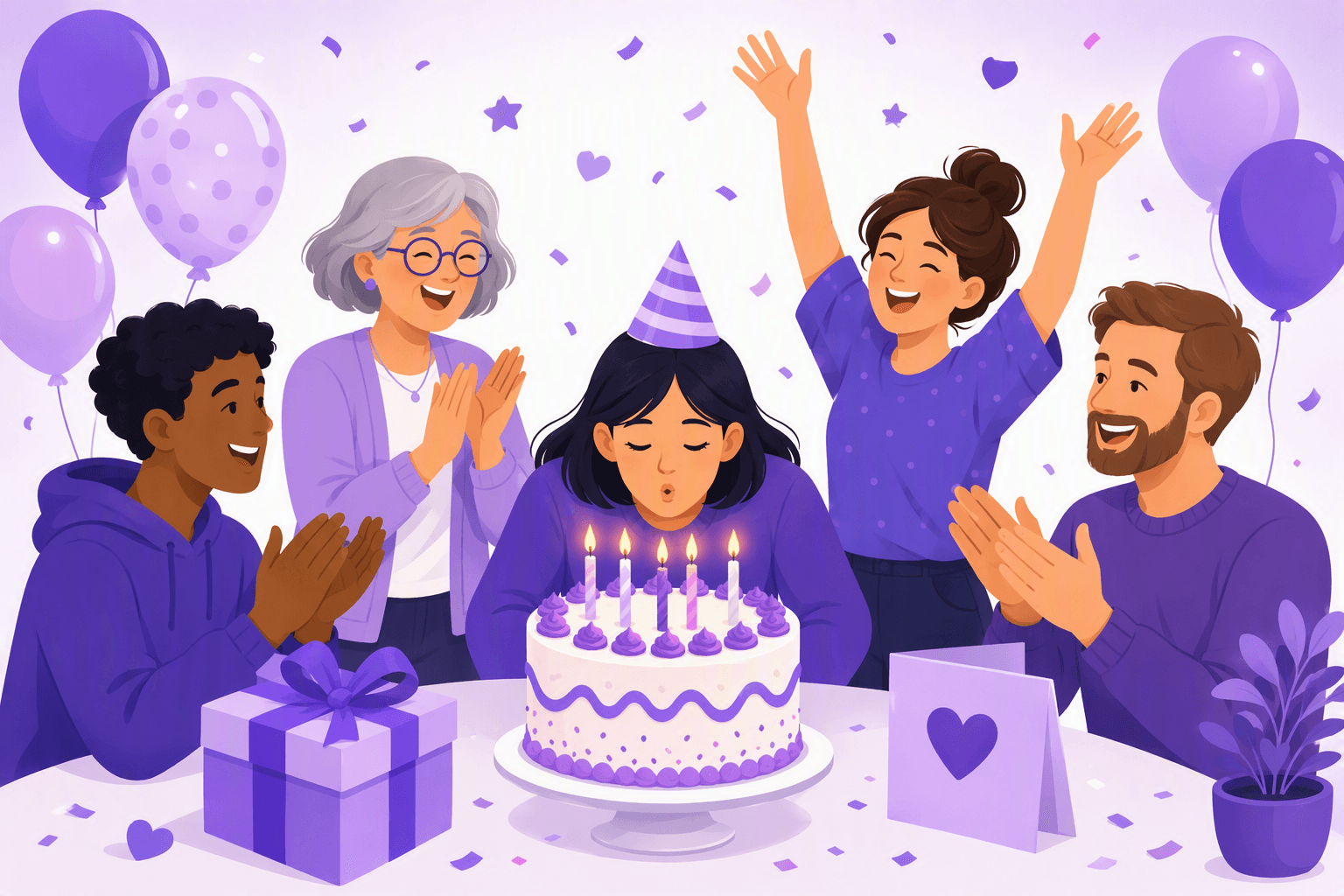
The traditional order is: candles burn on the birthday cake, everyone sings the song, the person makes a wish and blows out the candles. One important detail is that the wish stays secret. If you say it out loud, it will not come true. This ritual appears at birthday parties in the United States, England, Australia, and Canada almost without exception.
In the fourth line, people replace “dear [name]” with the person’s name. If the name has many syllables, singers usually slow down to fit it into the melody. People improvise this as needed.
🌍 The song and copyright
The “Happy Birthday to You” song was under copyright protection in the United States for decades. A 2016 court ruling finally placed it in the public domain, after it became clear that Warner/Chappell Music had maintained the claim without proper rights. This explains why, for a long time, some films and TV shows used only instrumental versions.
How to respond to a birthday greeting
In English-speaking culture, your response to a birthday greeting also matters. Like in English, people do not say very little at this moment, but an elegant, natural reply can differ from what you learned in school.
| Greeting | Reply | English equivalent |
|---|---|---|
| Happy birthday! | Thank you so much! | Thank you so much! |
| Many happy returns! | Thank you, that's very kind! | Thank you, that's very kind! |
| Wishing you all the best! | Thank you! I really appreciate it. | Thank you! I really appreciate it. |
| Hope you have a great day! | Thanks! I'm sure I will. | Thanks! I'm sure I will. |
| You don't look a day over thirty! | Ha! Thank you, you're too kind. | Ha! Thank you, you're too kind. |
💡 How much thanks to give
In English, plain “Thanks” can sound very short and a bit cold if you know the person well. For close friends, at least “Thanks so much!” or “Thank you!” sounds natural. If someone made a special effort for you (for example, a surprise party), “Thank you, that means so much to me” is one of the warmest and most natural reactions.
In English, it is also common to share a small detail about your day when you reply: “Thank you! We're going out for dinner tonight, I'm so excited." This makes it easier to continue the conversation and strengthens the connection.
Birthday-related vocabulary
In English, many key phrases connect to birthday celebrations. Without them, it is hard to communicate naturally at parties held in English.
| English | English | Pronunciation | Note |
|---|---|---|---|
| Birthday cake | birthday cake | /ˈbɜːrθdeɪ keɪk/ | Decorated with candles, people blow them out after singing |
| Candle | candle | /ˈkændəl/ | Placed on top of the cake, one for each year of age |
| Wish | wish | /wɪʃ/ | Made before blowing out the candles, in secret, because if you say it, it will not come true |
| Party | party | /ˈpɑːrti/ | Commonly: 'birthday party' |
| Surprise party | surprise party | /sərˈpraɪz ˈpɑːrti/ | The person does not know about it, a typical English-speaking tradition |
| Gift / present | gift / present | /ɡɪft/ / /ˈprɛzənt/ | 'Gift' is more formal, 'present' is more casual |
| Birthday card | birthday card | /ˈbɜːrθdeɪ kɑːrd/ | Often seen as almost required in English-speaking culture |
| Birthday boy / birthday girl | birthday boy / birthday girl | /ˈbɜːrθdeɪ bɔɪ/ / /ˈbɜːrθdeɪ ɡɜːrl/ | Also used for adults in a humorous context |
| Milestone birthday | milestone birthday | /ˈmaɪlstoʊn ˈbɜːrθdeɪ/ | 30, 40, 50, etc., people often celebrate these more |
| Blow out the candles | blow out the candles | /bloʊ aʊt ðə ˈkændəlz/ | Happens after the song and the wish |
In English-speaking birthday culture, the birthday card matters a lot. British people, in particular, keep a strong tradition. According to the Greeting Card Association’s 2023 data, people in the United Kingdom send about 900 million greeting cards per year, and a large share relates to birthdays. In shops, you often see whole aisles of cards for different ages and relationships.
Practice with real English content
You learn birthday greetings, and English in general, best in real, natural contexts. In native films and series, you can find many birthday scenes where people say the phrases above out loud, with authentic stress and body language.
The best movies to learn English page helps you choose titles where everyday English, including celebratory greetings, appears in the most natural form.
On the Wordy English learning page, you can watch films and series with interactive subtitles. Click any phrase to see pronunciation, meaning, and cultural context right away. This way you do not memorize abstract lists, you pick up birthday greetings from real dialogue, with natural intonation and context.
Frequently Asked Questions
How do you say “boldog születésnapot” in English?
What does “Many happy returns” mean?
How do you write a birthday message in English?
What do people sing for birthdays in English?
How should you respond to birthday wishes in English?
Sources & References
- Crystal, David (2019). The Cambridge Encyclopedia of the English Language. Cambridge University Press, 3rd edition.
- Merriam-Webster Dictionary (2026). merriam-webster.com.
- Oxford English Dictionary (2025). oed.com.
- British Council (2023). English Language Teaching: Global Research Report.
Start learning with Wordy
Watch real movie clips and build your vocabulary as you go. Free to download.


