Quick Answer
The most natural way to say good morning in Korean is '좋은 아침이에요' (Joeun achimieyo), but traditionally Koreans use '안녕하세요' (Annyeonghaseyo) at any time of day, including morning. Among close friends you can say '좋은 아침' (Joeun achim) or even '잘 잤어?' (Jal jasseo?, meaning 'Did you sleep well?'). Korean morning greetings also include food-related expressions like '밥 먹었어?' (Bap meogeosseo?, meaning 'Have you eaten?'), reflecting the culture's deep connection between meals and care.
The Short Answer
The most direct way to say good morning in Korean is 좋은 아침이에요 (Joeun achimieyo). However, the greeting you will hear most often in the morning is still 안녕하세요 (Annyeonghaseyo), the universal Korean greeting that works at any time of day.
Korean is spoken by over 80 million people worldwide, according to Ethnologue's 2024 data. Unlike English, Spanish, or German, traditional Korean does not carve greetings into morning, afternoon, and evening categories. The concept of a dedicated "good morning" phrase is a relatively recent adoption, driven by Western cultural influence and modern workplace norms.
"Korean greeting conventions are fundamentally relational rather than temporal. The critical variable is not when you greet someone, but who you are greeting and what your social relationship demands."
(Ho-Min Sohn, The Korean Language, Cambridge University Press, 1999)
This guide covers 16 Korean morning greetings and related expressions, organized by formality and context. Each includes Hangul script, romanization, pronunciation, an example sentence, and cultural notes so you know exactly when and how to use it.
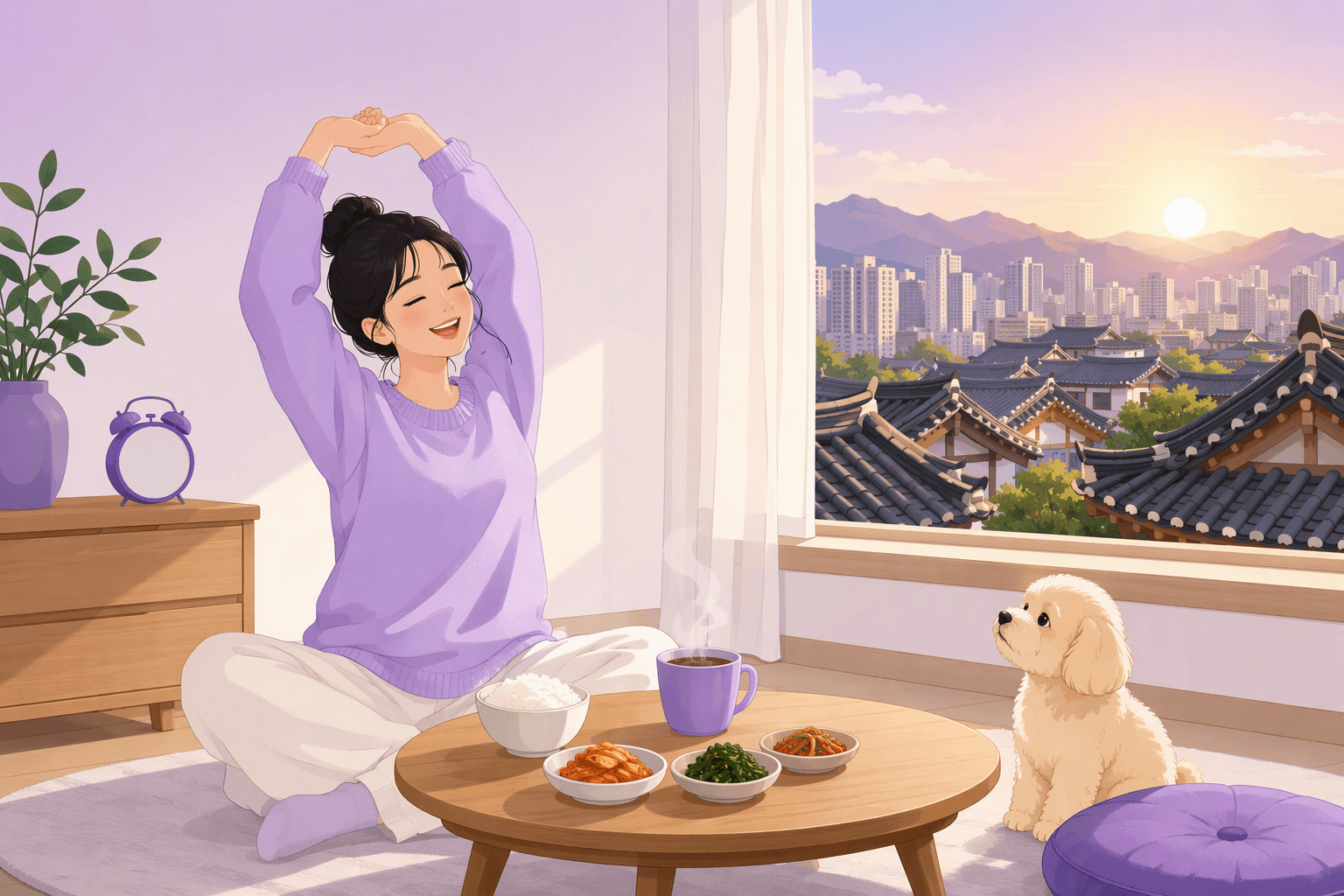
Quick Reference: Korean Morning Greetings at a Glance
| English | Korean | Pronunciation | Formality |
|---|---|---|---|
| Good morning (polite) | 좋은 아침이에요 | Jo-eun a-chi-mi-e-yo | polite |
| Good morning (casual) | 좋은 아침 | Jo-eun a-chim | casual |
| Good morning (formal) | 좋은 아침입니다 | Jo-eun a-chim-im-ni-da | formal |
| Hello (universal) | 안녕하세요 | An-nyeong-ha-se-yo | polite |
| Hello (formal) | 안녕하십니까 | An-nyeong-ha-shim-ni-kka | very formal |
| Did you sleep well? (polite) | 잘 잤어요? | Jal ja-sseo-yo | polite |
| Did you sleep well? (casual) | 잘 잤어? | Jal ja-sseo | casual |
| Wake up! | 일어나! | I-reo-na | casual |
| Have you eaten? (polite) | 밥 먹었어요? | Bap meo-geo-sseo-yo | polite |
| Have you eaten? (casual) | 밥 먹었어? | Bap meo-geo-sseo | casual |
| Have a good day (polite) | 좋은 하루 보내세요 | Jo-eun ha-ru bo-nae-se-yo | polite |
| Have a good day (formal) | 좋은 하루 보내십시오 | Jo-eun ha-ru bo-nae-ship-si-o | formal |
| Good morning (texting slang) | 굿모닝 | Gut-mo-ning | slang |
| I'm heading out (polite) | 다녀오겠습니다 | Da-nyeo-o-get-seum-ni-da | formal |
| Have a good day at work | 오늘도 힘내세요 | O-neul-do him-nae-se-yo | polite |
| Did you sleep comfortably? (formal) | 안녕히 주무셨어요? | An-nyeong-hi ju-mu-syeo-sseo-yo | polite |
Why Korean Doesn't Have a Traditional "Good Morning"
Before exploring individual phrases, it helps to understand a key difference between Korean and many Western languages. In English, greetings shift with the clock: good morning, good afternoon, good evening. Korean traditionally operates differently.
The greeting 안녕하세요 (Annyeonghaseyo), literally "Are you at peace?", functions as a universal greeting at any hour. The National Institute of Korean Language (국립국어원) classifies it as the standard greeting without any time-of-day restriction. Whether you encounter someone at 7 AM or 11 PM, 안녕하세요 is always appropriate.
The phrase 좋은 아침이에요 (Joeun achimieyo) is a calque, a word-for-word translation of "good morning" from English. It entered common usage through Korean corporate culture, where Western-style workplace norms became prevalent starting in the 1990s. Today it is widely understood and used, especially among younger Koreans and in office environments, but it still carries a faintly modern, cosmopolitan flavor that traditional greetings do not.
🌍 Time-of-Day Greetings Are a Western Import
Korean, Japanese, and Chinese all historically lack the rigid morning/afternoon/evening greeting system found in European languages. In all three, a single universal greeting covers the entire day. The spread of time-specific greetings in East Asia is a well-documented case of linguistic borrowing driven by globalization and Western business culture.
"Good Morning" in Three Speech Levels
Korean speech levels determine how you say nearly everything, and morning greetings are no exception. Here are the three core forms of "good morning" arranged from most formal to most casual.
좋은 아침입니다 (Joeun Achimimnida)
/Jo-eun a-chim-im-ni-da/
Literal meaning: It is a good morning
“좋은 아침입니다, 부장님. 오늘 회의 준비 완료했습니다.”
Good morning, Director. I have finished preparing for today's meeting.
The formal-level morning greeting. Used in business meetings, with superiors, during presentations, and in corporate announcements. The -ㅂ니다 ending signals high deference.
This is the morning greeting you would use with your company director, during a formal presentation, or in a corporate email. As Yeon and Brown explain in Korean: A Comprehensive Grammar (Routledge, 2011), the -ㅂ니다 ending is grammatically required in contexts demanding institutional formality. In casual conversation, this would sound overly stiff.
좋은 아침이에요 (Joeun Achimieyo)
/Jo-eun a-chi-mi-e-yo/
Literal meaning: It is a good morning
“좋은 아침이에요! 커피 한 잔 할래요?”
Good morning! Want to grab a cup of coffee?
The polite-level morning greeting. Works well with coworkers, acquaintances, and people you interact with daily but are not extremely close to. The most commonly used form of 'good morning' in modern Korean.
This is the sweet spot, polite enough for most situations without sounding ceremonial. You will hear it in Korean offices, cafes, and among neighbors in apartment buildings. The -이에요 ending keeps it respectful while remaining warm and approachable.
좋은 아침 (Joeun Achim)
/Jo-eun a-chim/
Literal meaning: Good morning
“좋은 아침! 오늘 날씨 진짜 좋다.”
Good morning! The weather is really nice today.
The casual form: just the bare phrase without a polite ending. Use only with close friends, siblings, or romantic partners. Dropping the verb ending is a hallmark of casual Korean speech (반말 banmal).
Strip away the verb ending and you get the casual version. This is 반말 (banmal) territory, reserved for people you are genuinely close to. Using 좋은 아침 with a stranger or elder would feel abrupt and overly familiar.
Universal Morning Greetings
These are the greetings Koreans actually use most often in the morning, even though they are not morning-specific.
안녕하세요 (Annyeonghaseyo)
/An-nyeong-ha-se-yo/
Literal meaning: Are you at peace?
“안녕하세요! 오늘 아침에 일찍 오셨네요.”
Hello! You came early this morning.
Still the most common greeting Koreans use in the morning. Works at any time of day. If you learn only one Korean greeting, this is it: morning, afternoon, or evening.
Despite the existence of 좋은 아침이에요, the reality is that most Koreans will greet you with 안녕하세요 in the morning. According to the King Sejong Institute's educational guidelines, this is the first greeting Korean learners should master, and for good reason: it never fails regardless of time, context, or relationship.
안녕하십니까 (Annyeonghasimnikka)
/An-nyeong-ha-shim-ni-kka/
Literal meaning: Are you at peace? (formal)
“안녕하십니까. 오늘 아침 조회를 시작하겠습니다.”
Good morning. I will now begin this morning's briefing.
The formal-level version of 안녕하세요. Used in morning meetings, military roll calls, news broadcasts, and corporate briefings. You hear it at the start of every Korean morning news segment.
Turn on any Korean morning news program and the anchor's first word will be 안녕하십니까. In military settings, morning formations use this greeting exclusively. It is the default opening for any formal morning event: company briefings, school assemblies, and public ceremonies.
Sleep-Related Morning Greetings
These phrases connect directly to the morning context of waking up and are among the most natural ways Koreans greet each other in the early hours.
잘 잤어요? (Jal Jasseoyo?)
/Jal ja-sseo-yo/
Literal meaning: Did you sleep well?
“잘 잤어요? 어젯밤에 비가 많이 왔는데.”
Did you sleep well? It rained a lot last night.
A warm, caring morning greeting used between family members, housemates, and people who spent the night in the same space. More personal than 좋은 아침이에요 because it implies closeness.
This greeting feels inherently intimate. You are acknowledging that you know the other person was sleeping nearby. Korean families use it every morning at the breakfast table. It also appears frequently between couples and close friends who live together or stayed over.
잘 잤어? (Jal Jasseo?)
/Jal ja-sseo/
Literal meaning: Did you sleep well?
“잘 잤어? 나 어젯밤에 꿈 엄청 무서운 거 꿨어.”
Did you sleep well? I had a really scary dream last night.
The casual version, used between close friends, siblings, couples, or children. Extremely common in Korean households every single morning.
The casual counterpart. In Korean dramas, you will hear this exchanged between family members over breakfast or between couples waking up together. It is one of the most authentically Korean morning greetings, far more traditional than any translation of "good morning."
안녕히 주무셨어요? (Annyeonghi Jumusyeosseoyo?)
/An-nyeong-hi ju-mu-syeo-sseo-yo/
Literal meaning: Did you sleep peacefully?
“할머니, 안녕히 주무셨어요? 아침 차려 드릴게요.”
Grandmother, did you sleep well? I'll prepare breakfast for you.
An honorific morning greeting using the respectful verb 주무시다 (jumusida) instead of the plain 자다 (jada, to sleep). Used when greeting elders (grandparents, parents, or elderly neighbors) to show deep respect.
The verb 주무시다 (jumusida) is the honorific form of 자다 (jada, to sleep). Using it elevates the greeting to show genuine respect for the listener. This is how Korean children greet their grandparents in the morning, and how younger adults address elderly neighbors. The honorific system, as Sohn describes in The Korean Language, is not optional politeness but a grammatical requirement when referring to the actions of social superiors.
Waking Someone Up
일어나! (Ireona!)
/I-reo-na/
Literal meaning: Get up!
“일어나! 학교 늦겠다. 빨리!”
Wake up! You're going to be late for school. Hurry!
The standard way to wake someone up in casual speech. Parents say it to children, friends say it to friends. The polite version is '일어나세요' (Ireonaseyo), used less often since you typically only wake up people you are close to.
Every Korean child has heard this shouted by a parent at least a thousand times. It is direct and urgent, the Korean equivalent of "Get up!" The polite form 일어나세요 (Ireonaseyo) exists but sounds oddly formal for the act of shaking someone awake. You would only use the polite version with a houseguest or someone you do not know well.
Food-Related Morning Greetings
Food occupies a central place in Korean morning culture. These greetings reflect that relationship.
밥 먹었어요? (Bap Meogeosseoyo?)
/Bap meo-geo-sseo-yo/
Literal meaning: Have you eaten rice?
“안녕하세요, 이모님. 밥 먹었어요?”
Hello, auntie. Have you eaten?
One of the most culturally distinctive Korean greetings. Traces back to periods of food scarcity when asking about meals was a genuine welfare check. Today it functions as a warm morning greeting expressing care. Especially common among older generations.
This greeting is a window into Korean cultural history. During the Korean War and the difficult decades that followed, food scarcity was a daily reality. Asking "Have you eaten?" was not small talk; it was a genuine expression of concern for survival. The word 식구 (sikgu), meaning "family," literally translates to "mouths to feed," underscoring how deeply food and care are intertwined in Korean culture.
Today, 밥 먹었어요? functions as a warm greeting rather than a literal question. The expected answer is simply 네, 먹었어요 (Ne, meogeosseoyo, "Yes, I ate"), regardless of whether you have actually eaten.
밥 먹었어? (Bap Meogeosseo?)
/Bap meo-geo-sseo/
Literal meaning: Have you eaten rice?
“밥 먹었어? 안 먹었으면 같이 먹자.”
Have you eaten? If not, let's eat together.
The casual version used between friends, family, and close acquaintances. Often followed by an invitation to eat together, reinforcing the communal aspect of Korean food culture.
The casual form naturally leads into an invitation to share a meal. In Korean culture, eating alone (혼밥, honbap) was traditionally seen as unfortunate, though attitudes are shifting among younger generations. The impulse to invite someone to eat when they have not is deeply ingrained.
🌍 Korean Breakfast Culture
Traditional Korean breakfast (아침밥, achimbap) is a full meal: rice, soup, kimchi, and several side dishes (반찬, banchan). It mirrors lunch and dinner rather than being a lighter meal as in many Western countries. This is why "Have you eaten?" carries such weight as a morning greeting. Breakfast in Korea is not a granola bar, it is a proper sit-down affair that shows someone cared enough to prepare it.
Morning Farewell Expressions
These phrases are used as you head out the door in the morning, making them an essential part of Korean morning communication.
좋은 하루 보내세요 (Joeun Haru Bonaeseyo)
/Jo-eun ha-ru bo-nae-se-yo/
Literal meaning: Please spend a good day
“좋은 아침이에요! 좋은 하루 보내세요.”
Good morning! Have a great day.
The Korean equivalent of 'Have a nice day.' Commonly used when parting ways in the morning: at a cafe, after a morning meeting, or when saying goodbye to a coworker heading to a different floor.
A natural pairing with any morning greeting. Baristas, receptionists, and coworkers use it as a polite send-off. It has become standard in Korean service industry interactions, much like "Have a nice day" in American English.
다녀오겠습니다 (Danyeoogesseumnida)
/Da-nyeo-o-get-seum-ni-da/
Literal meaning: I will go and come back
“아버지, 다녀오겠습니다.”
Father, I'm heading out (and will return).
Said when leaving the house in the morning. It is a promise to return safely, reflecting the Korean cultural value of family unity. The person staying home responds with '다녀와' (Danyeowa, meaning 'Go and come back') or the polite '다녀오세요' (Danyeoseyo).
This phrase is a cornerstone of Korean household morning routine. Children say it to parents before school. Spouses say it before leaving for work. The underlying meaning ("I will go out and come back") transforms a simple goodbye into a small promise of return. The response from the person staying home is equally ritualized: 잘 다녀와 (Jal danyeowa, "Go and come back safely") or the polite 다녀오세요 (Danyeoseyo).
오늘도 힘내세요 (Oneuldo Himnaeseyo)
/O-neul-do him-nae-se-yo/
Literal meaning: Stay strong today too
“좋은 아침이에요. 오늘도 힘내세요!”
Good morning. Stay strong today too!
An encouraging morning send-off. The word 힘 (him) means 'strength' or 'energy.' Common between coworkers and friends heading into a busy day. The casual form is '오늘도 힘내' (Oneuldo himnae).
Korean work culture is famously demanding, and this phrase acknowledges that reality with warmth. Saying 오늘도 힘내세요 to a coworker in the morning is both a greeting and an encouragement, a recognition that the day ahead requires effort, paired with a wish that they find the strength for it.
Modern and Slang Morning Greetings
굿모닝 (Gunmoning)
/Gut-mo-ning/
Literal meaning: Good morning (English loanword)
“굿모닝~ 오늘 뭐 해?”
Good morning~ What are you doing today?
The English phrase 'good morning' written in Hangul. Very common in text messages, KakaoTalk, and social media among younger Koreans. Carries a playful, lighthearted tone. Would sound odd in formal or face-to-face settings.
Konglish (the blending of Korean and English) is a major feature of modern Korean, especially in digital communication. 굿모닝 is pure Konglish: the English phrase "good morning" transliterated into Hangul characters. You will see it constantly on KakaoTalk and Instagram stories. It is playful and casual, never used in formal contexts.
Korean Workplace Morning Culture
Morning interactions in Korean offices follow specific patterns that combine language and behavior. Understanding these conventions is essential for anyone working in a Korean company.

| Situation | What to Say | Notes |
|---|---|---|
| Arriving at the office | 안녕하세요 or 좋은 아침입니다 | Bow slightly to superiors |
| Greeting your direct boss | 안녕하십니까, 과장님/부장님 | Use their title, deeper bow |
| Greeting a coworker | 좋은 아침이에요 or 안녕하세요 | Slight nod is sufficient |
| Morning team meeting | 안녕하십니까 (to the group) | The meeting leader opens with this |
| Arriving late | 죄송합니다, 늦었습니다 (Sorry, I'm late) | Apologize before greeting |
In Korean corporate culture, the 아침 인사 (achim insa, the morning greeting) is not optional. Failing to greet your superiors in the morning can be perceived as disrespectful. Many Korean companies hold brief morning assemblies (조회, johoe) where the entire team exchanges formal greetings before the workday begins.
💡 The Korean Office Morning Sequence
The typical Korean office morning follows a predictable pattern: arrive, greet the most senior person present with a bow and 안녕하십니까, greet coworkers with 안녕하세요 or 좋은 아침이에요, then settle in. If your boss arrives after you, stand briefly and greet them. This may feel excessive to Western workers, but in Korean workplace culture, these small rituals build and maintain professional relationships.
How to Respond to Morning Greetings
Knowing the right response is just as important as knowing the greeting itself.
| They Say | You Respond | Notes |
|---|---|---|
| 좋은 아침이에요 | 좋은 아침이에요 (echo it back) | Add a smile or slight bow |
| 안녕하세요 | 안녕하세요 | The universal safe response |
| 잘 잤어요? | 네, 잘 잤어요 (Ne, jal jasseoyo: "Yes, I slept well") | Even if you did not |
| 밥 먹었어요? | 네, 먹었어요 (Ne, meogeosseoyo: "Yes, I ate") | Literal truth is not required |
| 일어나! | 5분만... (O-bun-man...: "Just 5 more minutes...") | The universal human response |
| 다녀오겠습니다 | 다녀오세요 (Danyeoseyo: "Go and come back") | Or 잘 다녀와 (Jal danyeowa) casually |
⚠️ Match the Speech Level
Always match or exceed the formality of the greeting you receive. If someone greets you with the formal 좋은 아침입니다, respond at the same level, not with the casual 좋은 아침. Dropping to a lower speech level can signal that you consider yourself socially superior to the speaker, which may cause unintended offense.
Practice With Real Korean Content
Reading about morning greetings builds your vocabulary, but hearing them spoken naturally by native speakers is what transforms knowledge into instinct. Korean dramas are packed with morning scenes: families around the breakfast table in Reply 1988, tense office mornings in Misaeng, and couples exchanging sleepy greetings in Crash Landing on You.
Wordy lets you watch Korean movies and shows with interactive subtitles, tapping on any morning greeting to see its meaning, speech level, and cultural context in real time. Instead of memorizing phrases from a list, you absorb them from authentic conversations, complete with natural intonation, facial expressions, and the body language that accompanies each greeting.
For more Korean language guides, explore our blog or check out our recommended Korean movies for language learning. You can also visit our Korean learning page to start practicing today.
Frequently Asked Questions
What is the most common way to say good morning in Korean?
Does Korean have a traditional 'good morning' greeting?
Why do Koreans ask 'have you eaten?' as a morning greeting?
How do you say good morning to your boss in Korean?
Is it weird to say 좋은 아침 to older Koreans?
What is the difference between 좋은 아침이에요 and 좋은 아침입니다?
Sources & References
- National Institute of Korean Language (국립국어원), Standard Korean Language Dictionary
- King Sejong Institute Foundation, Korean Language Education Guidelines (2024)
- Sohn, H.-M. (1999). 'The Korean Language.' Cambridge University Press.
- Yeon, J. & Brown, L. (2011). 'Korean: A Comprehensive Grammar.' Routledge.
- Ethnologue: Languages of the World, Korean language entry (2024)
Start learning with Wordy
Watch real movie clips and build your vocabulary as you go. Free to download.


