Quick Answer
The most common English terms of endearment include “honey” (/ˈhʌni/), “darling” (/ˈdɑːrlɪŋ/), and “sweetheart” (/ˈswiːthɑːrt/) for relationships and close friendships, “love” (/lʌv/) in British English even for strangers (for example, a London waiter might say it), and “babe” (/beɪb/) and “baby” in younger, modern relationships. Not every pet name is romantic, “dear” (/dɪr/) and “love” in British English can be completely neutral.
The short answer
The most common words of endearment in English are honey, sweetheart, darling, babe, baby, love, dear, sweetie, angel, and boo. Which one fits depends on who you are talking to:
- For a partner: honey, babe, baby, sweetheart, darling, my love, boo
- For friends: buddy, mate, dude, hun, bestie
- For babies and kids: pumpkin, munchkin, sweet pea, little one, sunshine
- British: love, luv, pet, duck, hen, chuck
- Southern US: sugar, darlin', honey child
- Old-fashioned: dearest, beloved, turtle dove
Beyond the list itself, the world of English terms of endearment is much more culturally varied than it seems at first. A London taxi driver might naturally call a stranger love, while the same would feel odd to a New Yorker. Linguist David Crystal describes the English-speaking world in The Cambridge Encyclopedia of the English Language as a place where one of the richest informal vocabularies for expressing emotion has developed.
According to Ethnologue’s 2024 data, nearly 1.5 billion people speak or learn English worldwide, and this guide covers the pronunciation, cultural context, and pitfalls of the endearments they all use.
One key principle: not every term of endearment is romantic in English. In British English, love, dear, and pet can be neutral and natural, even between strangers. In the US, honey and sweetie can sound unusually friendly in the South, even with strangers. Context determines the meaning, and you should know that before you address someone in English.
With the Wordy app, you can hear these expressions in real English movies and series, in natural context, with authentic pronunciation and emotion.

Quick overview
| English | English | Pronunciation | Formality |
|---|---|---|---|
| Sweetie / Honey | Honey | /ˈhʌni/ | casual |
| Darling / Dear | Darling | /ˈdɑːrlɪŋ/ | casual |
| Sweetheart | Sweetheart | /ˈswiːthɑːrt/ | casual |
| Babe | Babe | /beɪb/ | slang |
| Baby | Baby | /ˈbeɪbi/ | casual |
| Angel | Angel | /ˈeɪndʒəl/ | casual |
| Love (British) | Love | /lʌv/ | casual |
| Dear | Dear | /dɪr/ | polite |
| Pet (Northern British) | Pet | /pɛt/ | casual |
| Sweetie | Sweetie | /ˈswiːti/ | casual |
| Hun (shortened) | Hun | /hʌn/ | slang |
| Pumpkin | Pumpkin | /ˈpʌmpkɪn/ | casual |
| Sunshine | Sunshine | /ˈsʌnʃaɪn/ | casual |
| Little one | Little one | /ˈlɪtəl wʌn/ | casual |
| Boo | Boo | /buː/ | slang |
| Sugar (Southern US) | Sugar | /ˈʃʊɡər/ | casual |
| Darlin' (Southern US) | Darlin' | /ˈdɑːrlɪn/ | casual |
| Duck (British) | Duck | /dʌk/ | casual |
| Hen (Scottish) | Hen | /hɛn/ | casual |
| Dearest (old-fashioned) | Dearest | /ˈdɪrɪst/ | polite |
Romantic terms of endearment
These expressions mainly live in romantic relationships, and they are the most classic endearments in English-speaking culture. In their research International English, Peter Trudgill and Jean Hannah point out that many of these words come from Old English and Middle English literature, yet they still feel alive and everyday today.
Honey
//ˈhʌni//
Literal meaning: Honey
“Good morning, honey. Did you sleep well?”
Good morning, sweetie. Did you sleep well?
In the US, this is one of the most common endearments between partners and from parents to children. In the South, especially in Southern states, people may even say it to strangers (for example, a waitress to a customer). In British English it is less common, and 'love' often fills that role.
The word honey literally means honey, and it became an endearment through the association with sweetness. The Oxford English Dictionary traces its endearment sense back to at least the 14th century. Today, in the US it is a very typical at-home form of address, natural in the kitchen, on the phone, and in texts.
“One special feature of English terms of endearment is that expressions tied to sweet tastes are especially durable. Honey and sweetheart remain part of everyday communication even after centuries.”
(David Crystal, The Cambridge Encyclopedia of the English Language, Cambridge University Press, 2019)
Darling
//ˈdɑːrlɪŋ//
Literal meaning: Darling / Dearest
“Come here, darling. I've got a surprise for you.”
Come here, darling. I've got a surprise for you.
It has a slightly British and elegant feel, and you hear it a lot in British films and BBC series. It is also used in the US, but less often than 'honey'. People say it to partners and from parents to children. It sounds old-fashioned, but not outdated, it still feels natural and warm.
Darling comes from Old English deorling (a very dear person). It is one of the oldest documented English endearments, used continuously from Shakespearean drama to today. It is especially common in British English and often associated with elegant, literary English, although it is also fully everyday now.
Sweetheart
//ˈswiːthɑːrt//
Literal meaning: Sweet heart
“You're such a sweetheart for remembering my birthday.”
You're so sweet for remembering my birthday.
A compound of 'sweet' and 'heart', attested from the 13th century. Natural in relationships and from parents to children. It often feels warmer and more intimate than 'honey', it suggests someone touches your heart.
Sweetheart is one of the most beautiful English compounds, it puts sweetness and the heart into one word. It is common in both the United Kingdom and the US. The everyday my sweetheart is especially popular from parents to children, and among older generations as a relationship term.
Babe / Baby
//beɪb//
Literal meaning: Baby / Small child
“Babe, have you seen my keys anywhere?”
Babe, have you seen my keys anywhere?
A modern, youthful relationship endearment. It is a shortened form of 'baby'. Common in texts, social media, and informal speech. Friends also use it, especially women with each other in the US ('Hey babe, what are you up to?'). Avoid it in formal situations.
Babe and baby are among the most common relationship endearments in modern English for younger generations. Merriam-Webster dates their endearment sense to the mid-20th century, but pop music and the internet spread them globally. Babe is shorter and more informal, and it is often the more typical form in writing.
Angel
//ˈeɪndʒəl//
Literal meaning: Angel
“You brought me coffee? You're an angel!”
You brought me coffee? You're an angel!
It expresses that someone is kind, sweet, and irreplaceable. Natural in relationships, from parents to children, and between friends. 'Angel' can stand alone ('Thanks, angel.'), and the more personal 'my angel' carries a deeper feeling.
Angel carries the idea of perfection, goodness, and care. It is especially typical when someone did something thoughtful: You remembered! You're an absolute angel. Parents also say it to young children, especially in British and Irish English.
What to call your boyfriend, girlfriend, or partner
If you just want a quick list of things to call your partner, this table covers the most common options and the feeling each one carries.
| Term | Feel | Best for |
|---|---|---|
| Honey | Warm, classic | Any stage of a relationship |
| Babe / Baby | Modern, casual | Established couples, texting |
| Boo | Playful, slang | Younger couples, social media |
| Bae | Internet slang | Mostly written, semi-ironic by now |
| Sweetheart | Tender, timeless | Any stage, also affectionate thanks |
| Darling | Elegant, slightly British | Couples who like a classic feel |
| My love | Intimate, sincere | Serious relationships |
| Angel | Grateful, admiring | Thanking a thoughtful partner |
| Handsome / Gorgeous | Compliment-style | Flirty greetings (Hey, handsome!) |
| Sunshine | Cheerful | Morning messages, upbeat couples |
A few of these deserve a note. Boo most likely comes from the French beau (beautiful, admirer), spread through 1990s hip-hop and R&B lyrics, and bae took off on social media in the 2010s as a clipped form of babe, now often used with a wink. For a boyfriend, the most natural picks are babe, honey, and compliment-style names like handsome; for a girlfriend, babe, sweetheart, gorgeous, and my love are all safe and common. The only real mistake is reaching for a very intimate form like my darling too early, which can feel heavy on a second date.
British endearments
In British English, there are a few endearments that many Americans do not use, and they are culturally very specific: people say them to strangers too. This is one of the most surprising differences between American and British English.
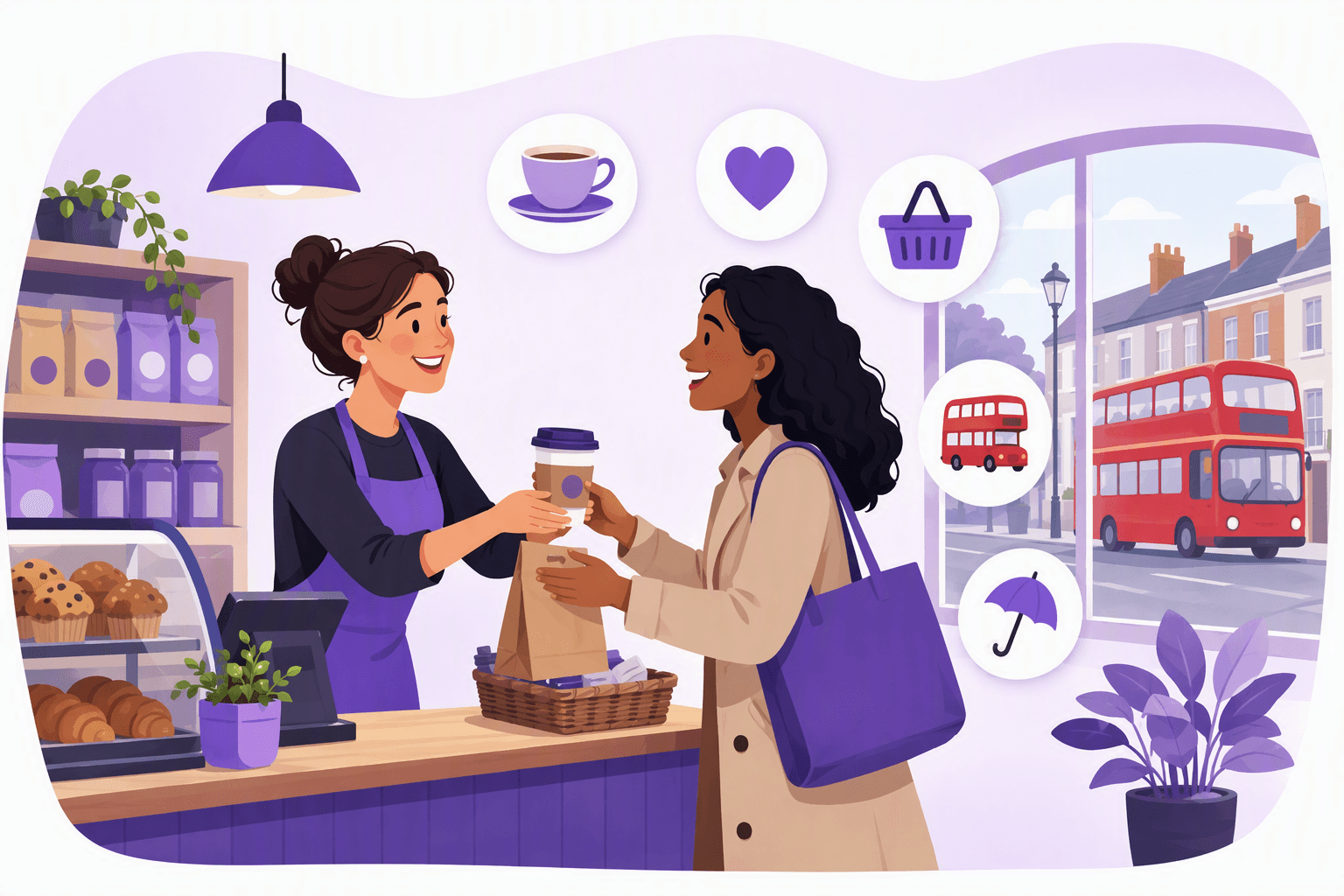
Love
//lʌv//
Literal meaning: Love / Affection
“What can I get you, love?”
What can I get you, love?
In British English, especially in Northern England, Yorkshire, and London, it is completely normal for staff in shops, cafes, or on buses to call unknown customers 'love'. In the US this would be unusual, where 'love' is almost always romantic. It is not flirting, it is just friendly British communication.
The endearment use of love can surprise many English speakers at first. In England, it can be a neutral, everyday form. A London bus driver, a Manchester bakery worker, or a Birmingham cafe server might naturally say: There you go, love. This is not romantic, it is simply one way British friendliness shows up.
🌍 Regional British endearments
In England, endearments are strongly regional. Yorkshire and Lancashire: love. East Anglia: my love and my dear. Scotland: hen and pal. Wales: lovely. Northern England and Scotland: pet. Textbooks rarely teach these regional forms, but they matter for understanding real British English.
Dear
//dɪr//
Literal meaning: Dear / Beloved
“Can I help you, dear?”
Can I help you, dear?
Mainly a British and Irish English form. It is especially common among older generations and in rural areas. Polite and warm, but a bit more restrained than 'love'. As a letter and email opener, the formal 'Dear Sir/Madam' uses the same word, but as an endearment it is fully informal.
Dear is one of the oldest English endearments, from Old English dēore (dear, valuable). Today it mainly lives as an endearment in British and Irish English. Written Dear... and spoken Yes, dear are two very different registers of the same word.
Pet
//pɛt//
Literal meaning: Pet / Darling
“Are you alright there, pet?”
Are you alright there, pet?
A typically Northern English and Scottish form, especially common in the Geordie dialect (Newcastle and the Tyne and Wear area). People may use it for unknown customers in shops and cafes. In the US it is almost unknown in this endearment role, where 'pet' means only an animal.
The endearment sense of pet is a feature of Northern English dialects. In Newcastle and the Tyne area it is so natural that tourists often react with surprise when someone in a shop calls them pet. Trudgill and Hannah’s International English documents in detail how British regional endearments vary by dialect.
Luv, duck, hen, and chuck
Beyond love, dear, and pet, Britain has a whole map of regional endearments, each tied to a specific area.
| Term | Region | Example |
|---|---|---|
| Luv | All over England (written form of love) | Cheers, luv! |
| Duck | East Midlands: Nottingham, Derby, Stoke-on-Trent | Ay up, duck! |
| Hen | Scotland, especially Glasgow (to women) | You alright, hen? |
| Chuck | Lancashire and Manchester | Come on, chuck. |
| Flower / Petal | Northern England | Thanks, flower. |
| Treacle | Cockney rhyming slang (treacle tart = sweetheart) | Alright, treacle? |
| My lover | West Country: Bristol, Devon | Alright, my lover? |
Luv is simply how the spoken love gets written in texts and dialogue. Duck, likely from an affectionate Old English duce, is standard in Stoke-on-Trent for all genders, hen is Glasgow’s friendly address for women, and my lover in Bristol carries no romantic meaning at all, which reliably startles visitors. These forms rarely appear in textbooks, but you will hear them within minutes of arriving in the right city.
Southern US terms of endearment
The American South has its own warm register of endearments, used far beyond romantic relationships. In Texas, Georgia, or Tennessee, a waitress may greet a complete stranger with sugar or hon, and it reads as hospitality, not flirting.
//ˈʃʊɡər//
Literal meaning: Sugar
“You doing alright, sugar?”
Are you doing alright, sweetie?
A signature endearment of the American South. Waitresses, cashiers, and older neighbors say it to strangers as a matter of course, especially to younger people. Like 'honey', it builds on the sweetness metaphor. Outside the South it sounds noticeably regional, and in a Northern office it would feel out of place.
Darlin', the clipped Southern form of darling, works the same way: What can I get you, darlin'? is standard diner English from Texas to the Carolinas. Other Southern favorites include sweet pea, honey child, sugar pie, and baby doll, most of them carried far beyond the South by country music.
🌍 British 'love' vs. Southern 'sugar'
England and the American South developed the same habit independently: friendly endearments for strangers, love, duck, and pet from British shop staff, sugar, hon, and darlin' from Southern waitresses. Both are neutral and warm, but they do not transplant: sugar in London or duck in Atlanta would raise eyebrows.
Friendly endearments
English has many endearments that are not romantic, but friendly or collegial. This often confuses people from other cultures.
Babe (between friends)
//beɪb//
Literal meaning: Baby / Small child
“Babe, you look amazing tonight!”
Babe, you look amazing tonight!
In the US, women often use it with each other as a friendly endearment, not romantically. It is typical among people under 30. Friendly 'babe' and relationship 'babe' sound identical, context decides the meaning.
In the US, babe as a friendly form between friends, mostly among women, is very common. Hey babe, what's up? can feel completely natural between two friends and carries no romantic meaning. This is one of the more distinctive patterns in English-speaking culture, and it helps to understand it to avoid misunderstandings.
Sweetie
//ˈswiːti//
Literal meaning: A diminutive of 'sweet'
“Thanks for helping me, sweetie. You're the best.”
Thanks for helping me, sweetie. You're the best.
You can say it to friends and partners. It is a diminutive form of 'sweet'. It is also natural from parents to children. It often feels warmer and more personal than 'honey'. Common in both the US and the United Kingdom.
Sweetie is a diminutive form of sweet. Friends, couples, and parents all use it. If someone did something nice and you feel grateful, You're a sweetie! is a natural reaction.
Hun
//hʌn//
Literal meaning: Short for 'honey'
“Thanks for the birthday message, hun! You're so sweet.”
Thanks for the birthday message, hun! You're so sweet.
A spoken and especially written shortening of 'honey'. It is common in texts and on social media. Popular among women in the US in friendly contexts. It feels more informal and relaxed than the full 'honey'.
Hun is typical in digital communication: texts, Instagram comments, and Facebook messages instead of honey. Love you, hun! can be a completely natural message between friends. Digital and mobile communication helped bring this shortening into everyday English.
More terms of endearment for friends
Friendly address terms follow different rules from romantic ones:
- Buddy / Bud: friendly and neutral in the US, works for close friends and casual acquaintances alike
- Pal: slightly older-feeling US and Scottish form (Thanks, pal)
- Mate: the default friendly address in Britain and Australia, used constantly between men and increasingly by everyone
- Dude / Man / Bro: casual American forms, mostly among younger speakers
- Bestie: the best friend, common in speech and social media captions
- Girl / Queen: enthusiastic friendly forms among women (Yes, queen!)
- Fam: internet-era slang for your closest circle
Most of these are gender-flavored rather than gender-fixed: mate and dude started as male-to-male forms but have broadened, while girl and hun live mostly in female friendships.
💡 Friendly vs. romantic: how can you tell?
If you are unsure whether an English endearment is romantic or friendly, watch the context:
- Romantic situation: between partners, often with a first-person possessive (my honey, my darling)
- Friendly: between friends, especially women with each other (Hey babe, Thanks hun)
- Neutral, British: staff say it to strangers (love, dear, pet)
British and American contexts differ a lot. What a London shop worker says (Yes, love?) would sound romantic in the US, but in England it can be neutral.
Between parents and children
In English, many endearments mainly live in parent-child relationships. These forms feel warm and playful, and they fit adult relationships less well, although they sometimes appear there too.
Pumpkin
//ˈpʌmpkɪn//
Literal meaning: Pumpkin
“Come on, pumpkin, time to brush your teeth.”
Come on, pumpkin, time to brush your teeth.
A typical endearment for children, especially in the US. Because of jack-o'-lantern culture and Thanksgiving food, pumpkin feels cozy and familiar in America. Because it can sound childish, it is less common in adult relationships, but it does happen.
In the US, pumpkin is one of the most popular endearments for children. You hear it less often between adult partners, but it is not unheard of. Pumpkin carries strong emotional associations in America, Thanksgiving, fall decor, and childhood, so it naturally became an endearment.
Sunshine
//ˈsʌnʃaɪn//
Literal meaning: Sunlight
“Good morning, sunshine! Did you have sweet dreams?”
Good morning, sunshine! Did you have sweet dreams?
A warm endearment for children, especially common as a morning greeting. The image of sunshine, warmth, cheer, positive energy, makes it a natural endearment. You can also say it romantically to a partner, but it is mainly a parental form.
Sunshine is one of the most poetic English endearments. It says someone warms your day like sunlight. Parents often use it in the morning, but you can also say it to a partner: You are my sunshine, which is also a classic English song.
Button
//ˈbʌtən//
Literal meaning: Button
“You're as cute as a button, aren't you?”
You're as cute as a button, aren't you?
The fixed English phrase 'cute as a button' suggests a button is small, round, and symmetrical, so it feels cute. Mainly an endearment for small children. You hear it mostly in the US and the United Kingdom.
The English phrase as cute as a button comes from 19th-century America, when small, perfectly shaped buttons symbolized sweetness and tiny charm. Button also works as a standalone endearment for small children, especially in the US.
Little one
//ˈlɪtəl wʌn//
Literal meaning: Little one
“Sleep tight, little one. Tomorrow is a new adventure.”
Sleep tight, little one. Tomorrow is a new adventure.
A gentle, parental endearment for small children. It has a lullaby feel. People do not say it to adults, it clearly belongs to parent-child vocabulary. Common in both the United Kingdom and the US.
Little one is one of the gentlest English parental endearments. You often hear it at bedtime, when comforting a sick child, or in warm parent-child moments. Crystal’s encyclopedia notes that these multi-word endearments are especially typical in English parental speech, compared with languages that rely more on complex diminutive systems.
The full parental repertoire is much bigger. Other common names for babies and kids include munchkin (from the little people in The Wizard of Oz), sweet pea, peanut, bug and little bug, kiddo, cutie pie, and bunny. Nearly all of them build on the same two ideas, smallness and sweetness, which is why they transfer so easily between families.
Old-fashioned and vintage terms of endearment
Some endearments have drifted out of everyday speech but survive in letters, films, and literature, and a few are enjoying an ironic revival.
| Term | Era or feel | Example |
|---|---|---|
| Dearest | Classic letter opener, 19th-20th century | My dearest Elizabeth... |
| Beloved | Literary, biblical register | My beloved wife |
| My dear | Polite, slightly formal affection | Of course, my dear. |
| Turtle dove | Courtship symbol since Elizabethan times | My sweet turtle dove |
| Lamb / Lambkin | Gentle, protective, Shakespearean | Poor lamb, you must be tired. |
| Treasure | Someone precious | You're an absolute treasure. |
| Honeybunch | Early 20th-century American | Come here, honeybunch. |
| Toots / Dollface | 1920s-1940s American slang | Hey, toots. (now dated or ironic) |
| Sweetie pie | Mid-century, still heard | Of course, sweetie pie. |
Shakespeare used sweet, lamb, chuck, and mouse as affectionate address in his plays, and the Oxford English Dictionary records sweetheart from the 13th century and darling from before the year 900, two of the longest-serving affectionate words in the language. Dearest and beloved survived in wartime letters well into the 20th century. Be careful with toots and dollface: today they sound like a black-and-white gangster film and would land as mockery rather than charm.
Words of endearment in other languages
English speakers reach for sweetness (honey, sugar) and smallness (baby, little one), and most languages build their endearments on the very same metaphors, with a few surprises.
| Language | Term | Literal meaning |
|---|---|---|
| Spanish | cariño, mi amor | affection, my love |
| French | mon chéri, mon chou | my darling, my cream puff |
| Italian | tesoro, amore | treasure, love |
| German | Schatz, Liebling | treasure, favorite |
| Japanese | あなた (anata) | you (used like "dear" between spouses) |
| Korean | 자기야 (jagiya) | roughly "honey, babe" |
Food metaphors are near-universal, but each culture picks its own dish: English chose honey, French the cream puff (mon chou), Spanish the media naranja, the “half orange” who completes you, while German and Italian prefer treasure. The Wordy blog has full endearment guides for Spanish, French, Italian, German, Japanese, and Korean.
Situations to avoid
English endearments are not appropriate in every situation. Cultural differences matter a lot here.
⚠️ Avoid endearments at work and in formal situations
English endearments belong to informal communication. Avoid them in the situations below, because they can sound rude or awkward:
- At work: Calling a colleague or boss honey, sweetie, or babe can seem unprofessional, and it may be seen as sexual harassment in English-speaking workplace culture.
- In a job interview: Do not use any endearments with the interviewer.
- In an email to a stranger: Dear + name is a formal opener, but honey and darling will sound inappropriate.
- With a new acquaintance: Unless you are in a British regional context where love is natural with strangers, do not use an endearment on first meeting.
One important exception: in healthcare, especially elder care, nurses and carers often call patients love or dear. In England this can feel natural and warm, not rude.
Summary table
| Endearment | Who says it, to whom | Context |
|---|---|---|
| Honey | Partners, parents to children, Southern US | Everyday US form, can be neutral in the South |
| Darling | Partners, parents, broader in British English | Classic, British and elegant feel |
| Sweetheart | Partners, parents to children | Warm, intimate, US and UK |
| Babe / Baby | Relationships, friends (among women) | Modern, youthful, informal |
| Angel | Partners, parents, friends as thanks | Expresses someone’s kindness |
| Love | British staff to strangers, partners | British regional, can be neutral |
| Dear | In British and Irish English, often older speakers | Restrained, polite, also used in formal writing |
| Pet | Northern English and Scottish dialects | Strongly regional British form |
| Sweetie | Friends, partners, parents | Warm, direct, US and UK |
| Hun | Friends (in writing) | Digital communication, texting |
| Pumpkin | Parents to small children | US-specific, childlike feel |
| Sunshine | Parents to children, partners | Morning, warm form |
| Button | For small children | Linked to “cute as a button” |
| Little one | Parents to small children | Lullaby-like, gentle form |
| Boo | Partners, young couples | Modern slang, from French beau |
| Sugar | Southern US, including strangers | Warm, hospitable, regional |
| Darlin' | Southern US partners and strangers | Clipped Southern form of “darling” |
| Duck | East Midlands (Stoke, Nottingham) | Regional British, all genders |
| Hen | Glasgow and Scotland, to women | Friendly Scottish address |
| Mate / Buddy | Friends, casual acquaintances | Neutral friendly forms, UK/AU and US |
| Munchkin | Parents to small children | Playful, from The Wizard of Oz |
| Dearest | Letters, literary contexts | Old-fashioned, nostalgic |
Practice with real English content
Learning English endearments from a book gives you a good base, but they only start to feel natural when you hear them in real context: in a movie, a series, a loud argument, or a whispered line, with real pronunciation and emotion.
With the Wordy app, you can watch real English movies and series with interactive subtitles. If a scene includes honey or darling, you can tap once to see pronunciation, cultural context, and example sentences, instead of breaking the viewing experience to search a dictionary.
In our guide to the best movies to learn English, you will find specific recommendations, from romantic comedies to British dramas, that help you anchor these expressions in real English.
Frequently Asked Questions
What is the most common English term of endearment?
Can you call strangers “love” or “dear” in English?
What does “pet” mean as a term of endearment in English?
What is the difference between “babe” and “baby” in English?
How should you address your partner in English?
What are some words of endearment?
What can I call my boyfriend or girlfriend?
Are terms of endearment appropriate at work?
Sources & References
- Crystal, David (2019). The Cambridge Encyclopedia of the English Language. Cambridge University Press, 3rd edition.
- Trudgill, Peter and Hannah, Jean (2008). International English. Routledge, 5th edition.
- Oxford English Dictionary (2025). oed.com.
- Merriam-Webster Dictionary (2026). merriam-webster.com.
Start learning with Wordy
Watch real movie clips and build your vocabulary as you go. Free to download.


