Klaar om te leren?
Kies een taal om te beginnen!
Snel antwoord
Engels is de taal van reizen, op vliegvelden, in hotels en restaurants wereldwijd kun je in het Engels communiceren. Belangrijke zinnen zijn: 'Where is...?' (/wɛr ɪz/), 'How much does this cost?' (/haʊ mʌtʃ dʌz ðɪs kɒst/), 'Could I have the bill, please?' (/kʊd aɪ hæv ðə bɪl/) en 'I need help, please.' (/aɪ niːd hɛlp/).
Het korte antwoord
Engels is de wereldtaal van reizen. Als je één zin in het Engels kent, kun je bijna overal communiceren. De belangrijkste is: "Could you help me, please?" (/kʊd juː hɛlp miː pliːz/). Daarmee laat je meteen zien dat je hulp nodig hebt en beleefd bent, op elk vliegveld, in elk hotel of op straat.
Volgens Ethnologue 2024 gebruiken bijna 1,5 miljard mensen Engels voor dagelijkse communicatie. Dat maakt het de meest verspreide lingua franca ter wereld. Taalkundige David Crystal (The Cambridge Encyclopedia of the English Language, Cambridge University Press, 2019) zegt dat Engels de enige taal is die op elk continent officieel is of veel wordt gebruikt. Het is ook de feitelijke standaardtaal in de luchtvaart, het toerisme en de hotelbranche.
"Engels is niet alleen een taal, het is de code die reizigers wereldwijd gebruiken om met elkaar te communiceren. Wie een paar beleefde zinnen leert, maakt meteen deel uit van dit wereldwijde gesprek."
(British Council, English Language Teaching: Global Research Report, 2023)
Deze gids bevat 50+ essentiële Engelse reiszinnen, gegroepeerd per situatie: luchthaven en douane, hotel, restaurant, vervoer, winkelen en noodgevallen. Bij elke zin krijg je uitspraak, een echte voorbeeldzin en culturele context. Zo weet je wanneer en hoe je het gebruikt.
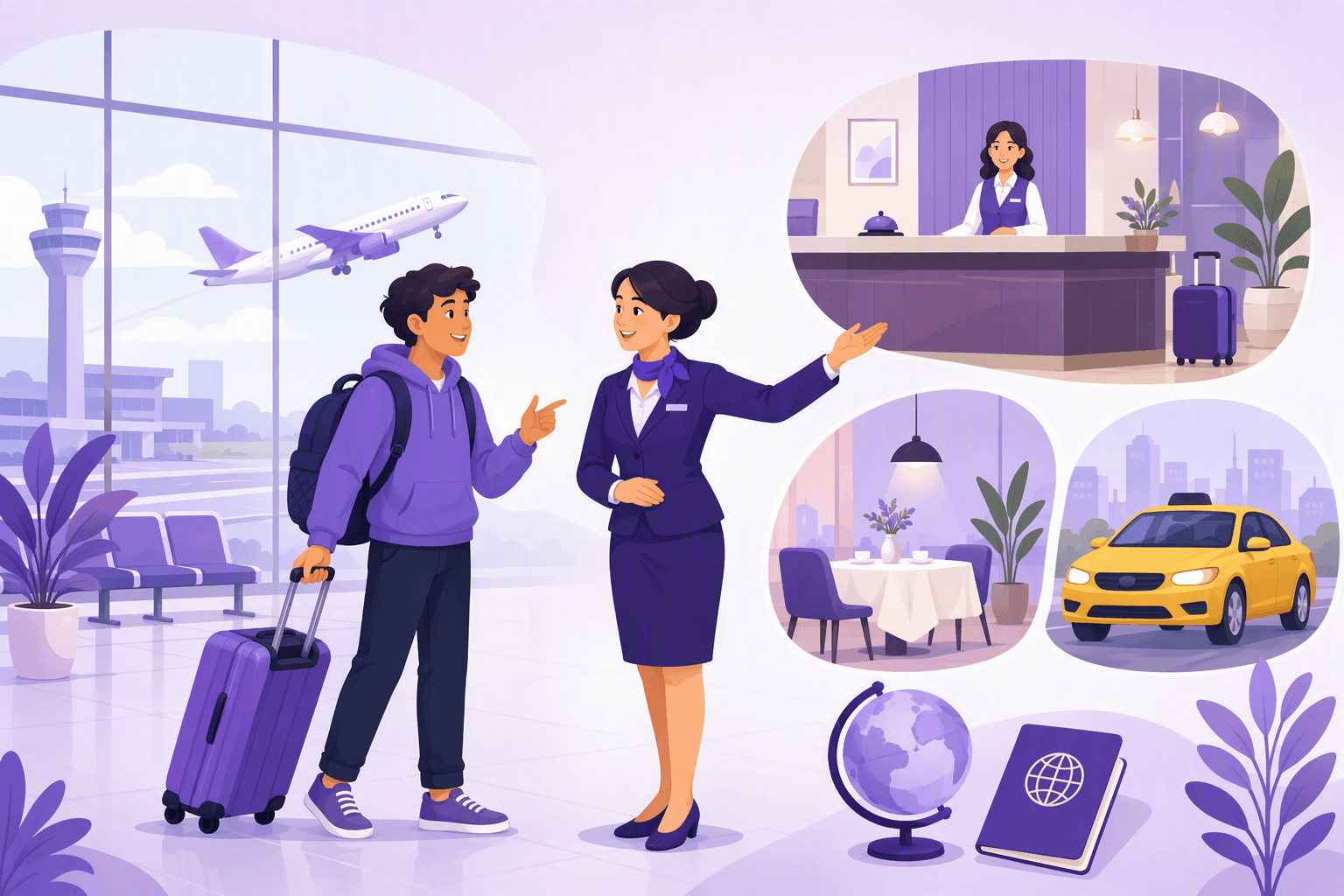
Snel overzicht: de 12 belangrijkste Engelse reiszinnen
| Engels | Uitspraak | Formaliteit |
|---|---|---|
| Where is...? | /wɛr ɪz/ | polite |
| How much does this cost? | /haʊ mʌtʃ dʌz ðɪs kɒst/ | polite |
| Could you help me, please? | /kʊd juː hɛlp miː pliːz/ | polite |
| I have a reservation | /aɪ hæv ə rɛzərˈveɪʃən/ | formal |
| Could I have the bill, please? | /kʊd aɪ hæv ðə bɪl pliːz/ | polite |
| I don't understand | /aɪ doʊnt ʌndərˈstænd/ | polite |
| Please speak more slowly | /pliːz spiːk mɔːr ˈsloʊli/ | polite |
| I need a doctor | /aɪ niːd ə ˈdɒktər/ | polite |
| Help! | /hɛlp/ | casual |
| Thank you | /θæŋk juː/ | polite |
| Please | /pliːz/ | polite |
| Excuse me | /ɪkˈskjuːz miː/ | polite |
Luchthaven en douane
Moderne luchthavens hebben bijna overal Engelstalige borden. Toch maken een paar kernzinnen je zelfstandiger. Dit is vooral belangrijk bij de douane en immigratie, waar beambten vaak vragen in het Engels stellen. De British Council zegt dat Engels de belangrijkste communicatietaal is op alle grote internationale luchthavens.
Where is the gate?
//wɛr ɪz ðə ɡeɪt//
Letterlijke betekenis: Where is the gate?
“Excuse me, where is gate B12?”
Excuse me, where is gate B12?
At the airport, 'gate' means the boarding gate, not the entrance. If you are lost, ask the staff. Airport workers are used to international passengers.
De structuur Where is...? is de meest flexibele manier om in het Engels de weg te vragen. Vervang de plek: Where is the baggage claim?, Where is the customs?, Where is the exit?.
Is this seat taken?
//ɪz ðɪs siːt ˈteɪkən//
Letterlijke betekenis: Is this seat taken?
“Excuse me, is this seat taken? Can I sit here?”
Excuse me, is this seat taken? Can I sit here?
You can use this in a waiting area, on a bus, or on a plane. If the seat is free, the answer is: 'No, go ahead.' If it is taken: 'Yes, sorry.'
Do you have anything to declare?
//duː juː hæv ˈɛniθɪŋ tə dɪˈklɛr//
Letterlijke betekenis: Do you have anything to declare?
“Do you have anything to declare?, No, just personal items.”
Do you have anything to declare?, No, just personal items.
Customs officers ask this question. A standard answer is: 'No, just personal belongings.' Stay calm and brief. Customs officers ask routine questions.
💡 Handige luchthavenwoorden
Een paar kernwoorden die je op borden ziet: Departures, Arrivals, Boarding, Gate, Baggage claim, Customs, Immigration, Transit. Je hoeft ze niet te zeggen. Je hoeft ze alleen te herkennen, dan beweeg je je met meer vertrouwen.
Hotel en accommodatie
Engelstalig hotelpersoneel, of dat nu in Londen, New York of Dubai is, is gewend aan internationale gasten en helpt graag. Het inchecken gaat bijna overal hetzelfde. Je geeft je naam, laat je paspoort zien en krijgt je sleutel.
I have a reservation
//aɪ hæv ə rɛzərˈveɪʃən//
Letterlijke betekenis: I have a reservation
“Good evening. I have a reservation under the name Kovács.”
Good evening. I have a reservation under the name Kovács.
At reception, greet first: 'Good morning / afternoon / evening.' This is basic politeness in English and sets a positive tone. The phrase 'under the name' means the booking is in that name.
Could I have a room for two nights?
//kʊd aɪ hæv ə ruːm fər tuː naɪts//
Letterlijke betekenis: Could I have a room for two nights?
“Could I have a double room for two nights, please?”
Could I have a double room for two nights, please?
'Could I have...?' is a basic polite request in English. Room types: 'single room', 'double room', 'twin room', 'suite'.
What time is check-out?
//wɒt taɪm ɪz tʃɛk aʊt//
Letterlijke betekenis: What time is check-out?
“What time is check-out? Can I leave my luggage here?”
What time is check-out? Can I leave my luggage here?
Check-out is usually between 11 a.m. and 12 p.m. If you want to stay longer, ask: 'Is a late check-out possible?' They usually allow it for an extra fee.
Could I have an extra towel?
//kʊd aɪ hæv ən ˈɛkstrə ˈtaʊəl//
Letterlijke betekenis: Could I have an extra towel?
“Excuse me, could I have an extra towel and some more soap?”
Excuse me, could I have an extra towel and some more soap?
In hotels, requests work best with 'Could I have...' or 'Could you bring me...'. Avoid 'Give me...'. It sounds rude in English.
🌍 Fooi in Engelstalige hotels
In de Verenigde Staten is het gebruikelijk om de bagagedrager en housekeeping fooi te geven: $1 tot $2 per koffer, en $2 tot $5 per dag voor het schoonmaken van de kamer. In het Verenigd Koninkrijk wordt het minder verwacht, maar mensen waarderen het wel. In Australië en Nieuw-Zeeland is fooi niet verplicht, maar het wordt geaccepteerd.
Restaurant en café
De Engelstalige restaurantcultuur kan anders aanvoelen, vooral in de Verenigde Staten. Bedienend personeel komt vaak terug naar de tafel. De ervaring is interactiever. Met een paar zinnen kun je met vertrouwen bestellen en betalen.
I'd like a table for two
//aɪd laɪk ə ˈteɪbl fər tuː//
Letterlijke betekenis: I'd like a table for two
“Hi, I'd like a table for two, please. Do you have a reservation?”
Hi, I'd like a table for two, please. Do you have a reservation?
In the United States and the United Kingdom, many restaurants require a reservation. If you do not have one: 'We don't have a reservation, do you have anything available?'
Could I see the menu?
//kʊd aɪ siː ðə ˈmɛnjuː//
Letterlijke betekenis: Could I see the menu?
“Could I see the menu, please? And could we get some water?”
Could I see the menu, please? And could we get some water?
In the United States, the menu is often already on the table, and the server usually brings free water automatically. In the United Kingdom and Australia, this is less automatic, so it is worth asking.
I'll have...
//aɪl hæv//
Letterlijke betekenis: I'll have...
“I'll have the grilled salmon and a side salad, please.”
I'll have the grilled salmon and a side salad, please.
'I'll have...' is the natural way to order. 'I want...' is correct, but it can sound too direct in a restaurant. 'I'll have...' sounds more polite and natural.
The bill, please / Check, please
//ðə bɪl pliːz / tʃɛk pliːz//
Letterlijke betekenis: The bill, please
“Excuse me, could we get the bill, please?”
Excuse me, could we get the bill, please?
Important cultural difference: in the United Kingdom and Australia people say 'bill'. In the United States and Canada people say 'check'. Both are understood everywhere. In the United States, the server often brings the check without you asking.
🌍 Fooi in restaurants: VS vs. VK
In de Verenigde Staten is fooi in restaurants 18 tot 20%. Dit is meestal het minimum, omdat bediening voor een groot deel van hun inkomen op fooi leunt. De rekensom is simpel: vermenigvuldig de rekening met 0.2. In het Verenigd Koninkrijk is 10 tot 12% gebruikelijk. Soms voegen ze automatisch servicekosten toe, controleer de rekening voordat je betaalt. In Australië en Nieuw-Zeeland is fooi niet verplicht, maar mensen ontvangen het graag.
Vervoer
Openbaar vervoer in Engelstalige steden, of dat nu de Londense metro, de New Yorkse subway of bussen in Sydney zijn, gebruikt Engelstalige borden en meestal Engelstalige omroepberichten. Een paar zinnen helpen als je een aansluiting mist of je halte niet kunt vinden.
How do I get to...?
//haʊ duː aɪ ɡɛt tuː//
Letterlijke betekenis: How do I get to...?
“Excuse me, how do I get to the city centre?”
Excuse me, how do I get to the city centre?
This is the most natural way to ask for directions in English. You can add: 'Is it far from here?', 'Can I walk?' or 'Should I take the bus or the subway?'
Where is the nearest...?
//wɛr ɪz ðə ˈnɪərɪst//
Letterlijke betekenis: Where is the nearest...?
“Where is the nearest ATM / pharmacy / subway station?”
Where is the nearest ATM / pharmacy / subway station?
With the word 'nearest', you can find almost anything. Useful places: 'ATM', 'pharmacy', 'hospital', 'taxi stand', 'bus stop'.
Could you take me to...?
//kʊd juː teɪk miː tuː//
Letterlijke betekenis: Could you take me to...?
“Could you take me to this address, please?”
Could you take me to this address, please?
One of the most useful sentences in a taxi. If you are not sure about pronunciation, show your phone with the destination. In the United States and the United Kingdom, Uber and Lyft or Bolt are very common. With these apps, you often do not need to say anything.
How much does it cost?
//haʊ mʌtʃ dʌz ɪt kɒst//
Letterlijke betekenis: How much does it cost?
“How much does it cost to get to the airport by taxi?”
How much does it cost to get to the airport by taxi?
In a taxi, ask the price before you leave, especially if there is no meter, or if the driver offers a 'flat rate'. With Uber and similar apps, you see the price before booking, which makes things easier.
Winkelen
Van winkelcentra tot buitenmarkten in Engelstalige landen, prijzen staan meestal aangegeven en afdingen is niet gebruikelijk. Uitzonderingen zijn antiekwinkels, rommelmarkten en sommige toeristenmarkten. Met deze zinnen kun je makkelijker winkelen.
How much is this?
//haʊ mʌtʃ ɪz ðɪs//
Letterlijke betekenis: How much is this?
“Excuse me, how much is this? And is it on sale?”
Excuse me, how much is this? And is it on sale?
'How much is this?' and 'How much does this cost?' mean the same, but the first sounds a bit more casual. 'Is it on sale?' helps you check for a discount. 'On sale' means discounted. 'For sale' means available to buy.
Do you have this in...?
//duː juː hæv ðɪs ɪn//
Letterlijke betekenis: Do you have this in...?
“Do you have this in a larger size / in blue?”
Do you have this in a larger size / in blue?
Clothing sizes vary by country: S, M, L, XL, or numeric sizes. If you do not know your size, ask: 'Could I try this on?'
Can I try this on?
//kæn aɪ traɪ ðɪs ɒn//
Letterlijke betekenis: Can I try this on?
“Can I try this on? Where is the fitting room?”
Can I try this on? Where is the fitting room?
'Fitting room' (US: 'dressing room') is where you try clothes on. Some stores limit how many items you can take in at once. If they say 'maximum 6 items', it is a normal policy, not personal.
Om hulp vragen en noodgevallen
Niemand plant een noodgeval, maar deze zinnen kunnen levens redden op een kritiek moment. In de Verenigde Staten is het noodnummer 911, in het Verenigd Koninkrijk is het 999, in Australië en de meeste andere Engelstalige landen is het 000 / 112.
I need help!
//aɪ niːd hɛlp//
Letterlijke betekenis: I need help!
“I need help! Please call an ambulance!”
I need help! Please call an ambulance!
In an urgent situation, this is the simplest and most effective sentence. If you can only say 'Help!' (/hɛlp/), that is enough. People understand it immediately in English-speaking countries.
I don't understand
//aɪ doʊnt ʌndərˈstænd//
Letterlijke betekenis: I don't understand
“I'm sorry, I don't understand. Could you repeat that?”
I'm sorry, I don't understand. Could you repeat that?
Do not be afraid to say this. Native speakers are used to learners and will often repeat or simplify. 'I'm sorry, my English is not very good' is also a helpful opener. It often makes the other person more patient.
Please speak slowly
//pliːz spiːk mɔːr ˈsloʊli//
Letterlijke betekenis: Please speak more slowly
“Could you speak more slowly, please? I'm still learning English.”
Could you speak more slowly, please? I'm still learning English.
Veel moedertaalsprekers, vooral Amerikanen, praten snel en slikken klanken in. Mensen reageren meestal vriendelijk op 'Could you speak more slowly?' 'Could you write it down?' is ook erg handig.
I've lost...
//aɪv lɒst//
Letterlijke betekenis: I've lost...
“I've lost my passport. Where is the nearest police station?”
I've lost my passport. Where is the nearest police station?
Als je documenten verliest, ga dan meteen naar het dichtstbijzijnde politiebureau en vraag om een rapport van vermissing. Je verzekeraar en je ambassade kunnen erom vragen. Bewaar een aparte kopie van je paspoort.
Call the police!
//kɔːl ðə pəˈliːs//
Letterlijke betekenis: Call the police!
“Call the police! I've been robbed!”
Call the police! I've been robbed!
Verenigde Staten: 911, Verenigd Koninkrijk: 999, Australië: 000, Canada: 911. Als je niet kunt bellen, roep: 'Help! Call the police!' Mensen om je heen zullen handelen. 'I've been robbed' en 'I've been attacked' zijn ook belangrijk bij noodgevallen.
Culturele tips
🌍 VK vs. VS: Ander Engels, andere gewoontes
Het Verenigd Koninkrijk en de Verenigde Staten hebben veel culturele en taalkundige verschillen. Als reiziger kunnen die je verrassen. Britten gebruiken vaak formelere beleefdheidsformules. 'Could I possibly...' en 'Would you mind...' komen vaker voor dan in de Verenigde Staten. Een Brit dringt niet voor in de rij. De 'queue' is bijna heilig in het Verenigd Koninkrijk. Die verstoren is een ernstige sociale overtreding.
In de Verenigde Staten is communicatie vriendelijker en directer. Zelfs een kassamedewerker kan vragen: 'How are you today?' Dit is geen echte vraag. Het is een beleefde formule. Een goed antwoord is: 'I'm great, thanks! And you?' Britten vinden die openheid soms te veel. Wat je prettig vindt, hangt af van je culturele achtergrond.
Noodnummers: Verenigde Staten en Canada: 911, Verenigd Koninkrijk: 999, Australië: 000, Nieuw-Zeeland: 111, Ierland: 112 / 999.
💡 Brits vs. Amerikaans Engels: Belangrijke verschillen voor reizigers
Een paar woorden die handig zijn om in beide varianten te kennen:
| Engels | Brits Engels | Amerikaans Engels |
|---|---|---|
| Restroom | Toilet / Loo | Restroom / Bathroom |
| Subway | Underground / Tube | Subway |
| Restaurant bill | Bill | Check |
| Vacation | Holiday | Vacation |
| Pharmacy | Chemist / Pharmacy | Drugstore / Pharmacy |
| Elevator | Lift | Elevator |
| Gas station | Petrol station | Gas station |
| Luggage | Luggage / Baggage | Luggage / Baggage |
Mensen begrijpen beide varianten in beide landen. Als je Britse woorden in de Verenigde Staten gebruikt, of andersom, kijkt niemand daarvan op.
Reiszinnenboekje: korte samenvatting
| Situatie | Handige zin in het Engels | Betekenis in het Nederlands |
|---|---|---|
| Luchthaven | Where is the gate? | Waar is de gate? |
| Douane | Just personal belongings. | Alleen persoonlijke spullen. |
| Hotel inchecken | I have a reservation under... | Ik heb een reservering op naam van... |
| Hotelverzoek | Could I have an extra...? | Mag ik een extra ...? |
| Uitchecken | What time is check-out? | Hoe laat is check-out? |
| Restaurant | I'll have... / The bill, please. | Ik neem ... / De rekening, alstublieft. |
| Route vragen | How do I get to...? | Hoe kom ik bij ...? |
| Taxi | Could you take me to...? | Kunt u me naar ... brengen? |
| Winkelen | How much is this? | Hoeveel kost dit? |
| Kleding passen | Can I try this on? | Mag ik dit passen? |
| Hulp | I need help! / Help! | Ik heb hulp nodig! / Help! |
| Noodgeval | Call the police! | Bel de politie! |
| Communicatie | Please speak more slowly. | Wilt u alstublieft langzamer spreken? |
| Herhalen | Could you repeat that? | Kunt u dat herhalen? |
Oefenen met echte Engelse content
De meest effectieve manier om deze zinnen te onthouden is ze te horen en te zien in echte context. Engelse films, series en podcasts zijn niet alleen leuk, ze leren je ook natuurlijke uitspraak, tempo en culturele verwijzingen.
Bekijk onze gids met de beste films om Engels te leren, met geselecteerde aanbevelingen uit zowel Britse als Amerikaanse producties. Als je tijdens het reizen wilt verbeteren, helpt onze app je om woorden en zinnen op een natuurlijke manier te leren op de pagina Engels leren met Wordy, terwijl je je favoriete series kijkt.
Lees ook onze gidsen over essentiële Engelse begroetingszinnen. Reizen gaat niet alleen om zinnen, maar ook om contact.
Veelgestelde vragen
Wat zijn de belangrijkste Engelse zinnen voor op reis?
Hoe vraag je in het Engels 'Waar is...?'
Hoe boek je een hotel in het Engels?
Hoe vraag je in het Engels om hulp bij een noodgeval?
Hoe zeg je in het Engels 'Ik begrijp het niet, herhaal het alsjeblieft'?
Bronnen en referenties
- Crystal, David (2019). The Cambridge Encyclopedia of the English Language. Cambridge University Press.
- British Council (2023). English Language Teaching: Global Research Report.
- Merriam-Webster Dictionary (2026). merriam-webster.com.
- Ethnologue (2024). Engels: wereldtaalstatus, 27e editie.
Begin met leren met Wordy
Kijk echte filmclips en bouw je woordenschat op terwijl je kijkt. Gratis te downloaden.


